By Lorand Vigh | GoToBirding
I have spent thirty years chasing birds.
Thirty years of pre-dawn alarms, muddy boots, and long drives to reserves I had read about in field guides. Thirty years of scanning tree canopies with binoculars, standing in cold fields and rain-soaked hides, waiting — always waiting — for something remarkable to appear.
I never questioned any of it. The effort, the discomfort, the hours of patience — it was all part of the practice. It was simply what birding was.
And then, in the space of one year, everything changed.
When the Field Became Unreachable
Last year, I had a serious eye surgery.
Not the kind you recover from in a weekend. The kind that comes with strict instructions: no strenuous activity, no long hikes, no physical exertion of any kind for an extended period. Rest. Stillness. Patience of a very different kind than the patience of waiting for a rare bird to show itself.
And then, before I had fully recovered, a second surgery. Another period of the same enforced stillness. Another stretch of months during which the fields, the reserves, the early mornings with binoculars — all of it was simply not available to me.
I want to be honest about what that felt like, because I think it is important.
For someone who has structured his life around being outdoors, around movement and observation and the particular quality of attention that field birding requires, the sudden removal of all of it was not a minor inconvenience. It was disorienting in a way that was difficult to explain to people who have not experienced it. The hobby that had been the constant thread running through thirty years of my life was, at least temporarily, gone.
I could not go to the birds.
What the Window Gave Me
I am not sure exactly when I started paying serious attention to the window.
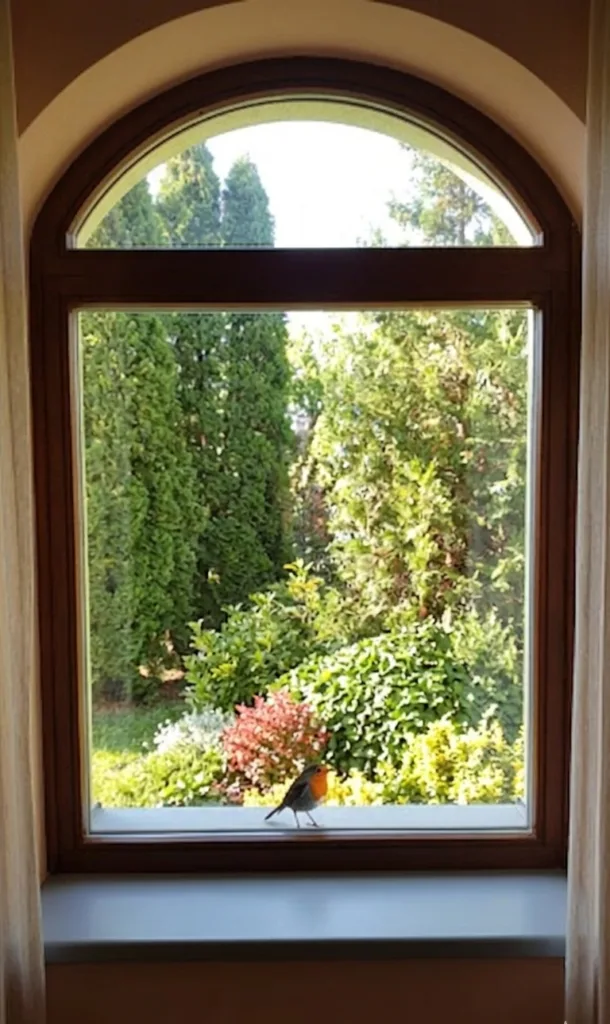
It happened gradually, the way things do when you have more time than usual to sit still. I noticed a great tit on the outside sill. Then a house sparrow. Then, one morning, a robin that sat for almost ten minutes on the narrow ledge outside the glass, looking in with what I can only describe as mutual curiosity.
I had seen thousands of robins, and I have photographed them in conditions that would test a professional wildlife photographer. I know their call, their territory habits, their remarkable tameness around humans.
But this robin, seen through glass from a chair during a period when I was supposed to be resting and doing nothing — this robin stopped me in a way that thirty years of field birding had not quite prepared me for.
There was no distance. No binoculars, no telephoto lens, no accumulated effort that had earned the sighting. Just a bird, a window, and an immediacy that felt almost startling in its simplicity.
And I thought: this is available to everyone.
Not just to someone with thirty years of experience and a car full of specialist equipment. Not just to someone with the physical ability to spend six hours in a hide or walk ten miles across a nature reserve. To anyone. In any home. On any floor. In any city.
That thought did not leave me.
Thirty Years of Birding, Two Surgeries, and One Honest Realisation
During those months of recovery — and I am still in this period as I write this, still rebuilding, still closer to the window than to the field — I had more time than usual to think about what birding actually is and what it actually gives people.
The birding world I have inhabited for three decades is wonderful. But it has a problem it rarely acknowledges: it asks a great deal before it gives anything back. Expensive gear. Physical mobility. Time. Transport. Accumulated knowledge. Years of practice before the experience begins to truly reward the effort invested.
Most people will never meet those requirements. Not because they lack interest or love for the natural world — but because life does not always make those things possible. Illness. Age. Urban living. Limited income. Young children. Disability. The hundred ordinary reasons why a person cannot spend a Saturday morning in a nature reserve.
I sat at my window during recovery and thought about all of those people. And I thought about this: what if the most powerful birding experience — not the most technically impressive, but the most genuinely moving — was actually available without any of the barriers? What if the window was enough?
It is enough. I know that now in a way I did not know it before, because I lived it.
What BirdClose™ Is — An Honest Account
I want to be straightforward with you, because this site has always been built on honesty and I am not going to change that now simply because I am writing about something I created myself.
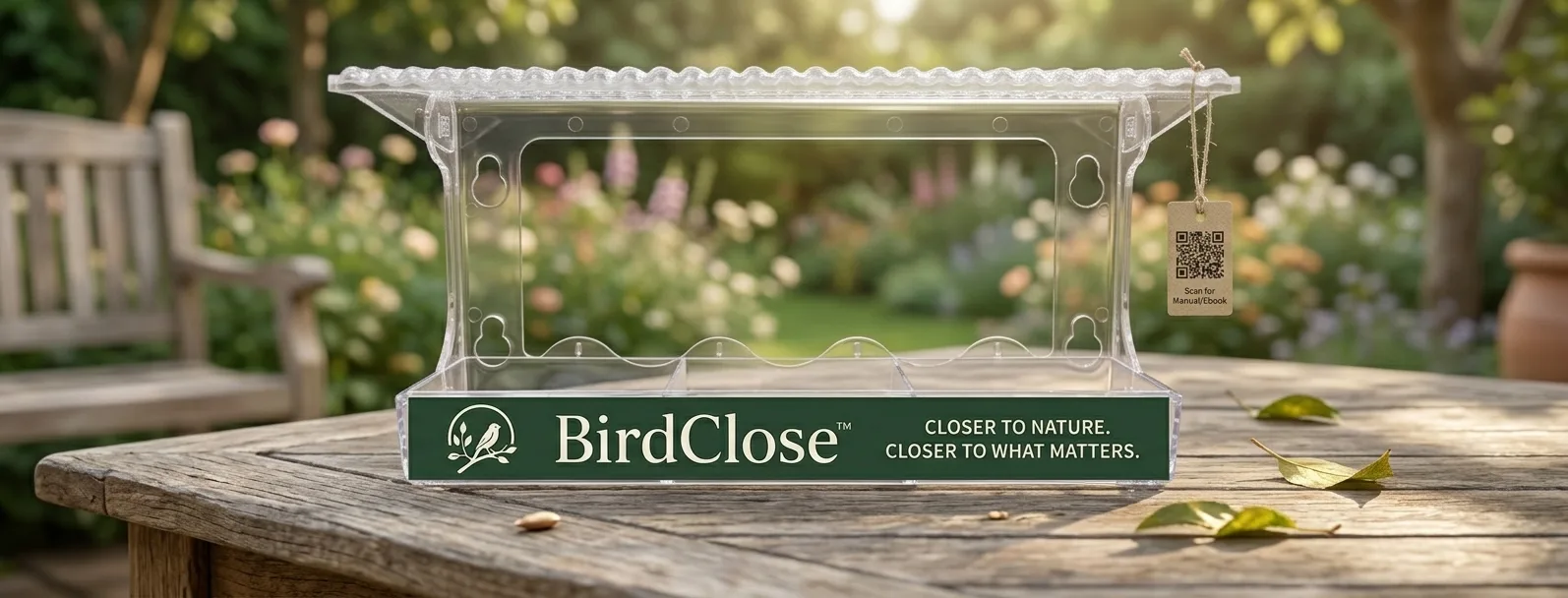
BirdClose™ is a brand I built during my recovery. It is a line of premium window bird feeders — clear acrylic, mounted on industrial-grade suction cups, designed to bring wild birds to any window and keep them there. The design is clean and considered: a roof that keeps seeds dry, drainage that prevents rot, materials chosen for long-term clarity and durability.
The feeders themselves are not complicated objects. What I have invested most heavily in is not the hardware — it is the knowledge that accompanies it. Because in thirty years of birding, the single most important thing I have learned is that the experience is almost entirely determined by what you know, not what you own.
Which window to choose. Which seeds actually work and which are a waste of money. How to read the behaviour of the first scout bird. Why a new feeder is quiet for the first few days and why that silence is progress, not failure. How to build the kind of patient, consistent routine that transforms a simple pane of glass into a place where wild things come willingly, day after day.
BirdClose™ 7-Day Roadmap
All of that knowledge — accumulated over thirty years, clarified during months of enforced stillness at a window — is what I tried to put into the BirdClose 7-Day Guide that comes with every feeder. Not as a marketing document. As a genuine attempt to compress decades of experience into something a complete beginner can use from day one.
That is what BirdClose is. A well-made feeder, thoughtful packaging, and everything I know about birds distilled into a guide that gives anyone — regardless of experience, mobility, or circumstance — the best possible chance of that moment. That closeness. That robin on the sill.
Why I Am Telling You This Here
Some of you have followed GoToBirding for a while. You know that this site is built on genuine experience. You know that when I recommend something, it is because I have thought carefully about it.
I am telling you about BirdClose here because I want to be completely transparent. This is my brand. I built it. I believe in what it does. And I am still, as I write this, in the middle of the recovery that inspired it — which means this is not a retrospective story about something that happened and led somewhere. It is a story still being written.
I also want to say something that might sound counterintuitive coming from someone who just launched a window feeder brand:
Window birding is not a lesser form of birding. For many people, it is the only form of birding — and that is not a compromise. It is a different kind of richness.
I did not fully understand this before last year. I understood it intellectually — I had always known that accessibility mattered, that birding should be for everyone. But I did not feel it until I was the person for whom the field was temporarily unreachable, and the window was all there was.
The window was enough. More than enough. It gave me something back during a period when I genuinely needed something to give.
Who This Is For
If you are a regular GoToBirding reader, you probably have a birding setup that works for you. You may not need a window feeder for your own practice — though I will tell you honestly that many experienced birders who have tried it describe it as one of the most surprisingly rewarding additions to their routine, particularly for close behavioural observation that field birding rarely provides.
But think about the people in your life who cannot access birding the way you can.
The person recovering from illness or surgery, sitting at home with time and stillness they did not choose. The older parent who used to walk in the countryside but can no longer. The friend in a city apartment who loves nature but has no idea how to find it from the third floor. The child who would be transformed by a close encounter with a wild bird if only someone gave them the opportunity.
Window birding is the most accessible entry point to the natural world I have ever encountered in thirty years of this hobby. No transport, no expensive gear, and no specialist knowledge on day one. Just a window, a feeder, and the willingness to sit quietly and pay attention.
If there is someone in your life who fits that description — or if you are, right now, in a period of your own where the field feels far away — I made BirdClose for you.
A Final Thought
I did not plan to build a brand during a period of recovery from eye surgery. I did not plan any of this.
But birding has always taught me that the most meaningful things arrive unexpectedly — that the bird you were not looking for is often the one that stays with you longest. That the moment you remember is rarely the one you planned for.
I was sitting at a window, doing nothing, waiting to heal. And a robin looked at me through the glass.
The rest followed from that.
BirdClose™ window bird feeders are available at birdclose.com. Every feeder includes the complete BirdClose 7-Day Guide to Bringing Nature Closer — a day-by-day roadmap built on thirty years of birding experience. The guide is also available as a standalone digital download for $4.99, ideal if you want to start before your feeder arrives.
This is my brand, built during my own recovery. I believe in it genuinely — not as a marketer, but as a birder who needed what it offers and found it in the simplest possible place: a window.
© 2026 GoToBirding | Lorand Vigh
Lorand Vigh is a nature conservation professional and lifelong birder based in Serbia (Vojvodina). With over 30 years of field experience in birdwatching, habitat protection, and conservation management, he has worked on bird monitoring projects, habitat restoration initiatives, and cross-border conservation cooperation. GoToBirding is a personal project built on real field experience, sharing practical, science-based advice for birders and wildlife photographers.