
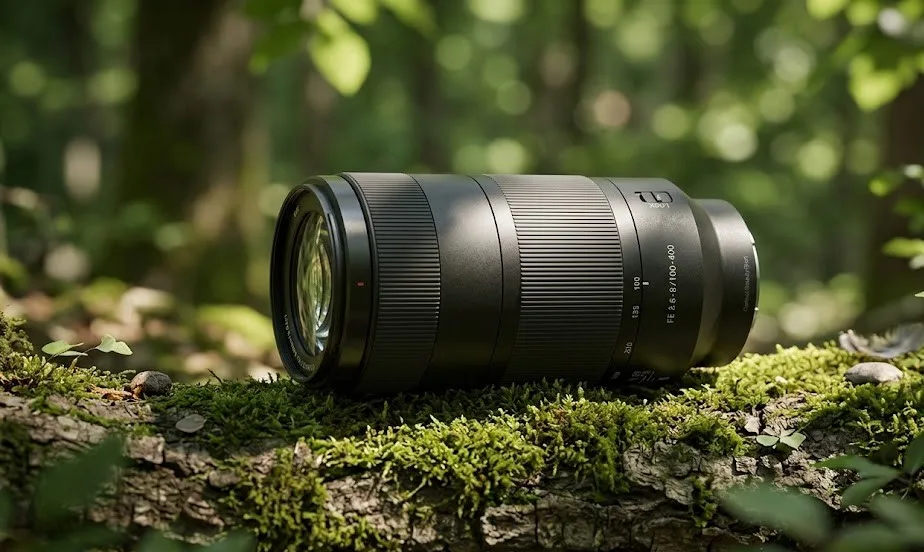
An exciting announcement recently shook up the outdoor photography community: Sony officially opened pre-orders on major retail platforms like Adorama for the Sony FE 100-400mm f/5.6-8 OSS. As a passionate birder constantly evaluating gear that balances reach with portability, this release immediately caught my attention.
Because the lens is currently in the pre-order phase and hasn’t started shipping to customers yet, I don’t have a physical unit on my desk for hands-on field testing. However, analyzing the official technical specifications alongside early community debates gives us a remarkably clear picture of what to expect. This isn’t just another telephoto zoom—it represents a distinct shift in how camera manufacturers address the needs of mobile outdoor photographers. My goal here is to dissect every aspect of this announcement, evaluate its practical implications for trail birding, and help you decide whether this pre-order deserves a spot in your setup.

The Evolutionary Arc of Sony’s Telephoto Ecosystem
To understand why this pre-order is generating so much discussion across forums and social media, we need to examine the history of Sony’s E-mount lineup. Reaching 400mm has long been considered the entry threshold for serious bird photography. Small songbirds, skittish shorebirds, and distant raptors require significant focal reach to capture meaningful detail without cropping your image so heavily that resolution degrades.
For years, full-frame Sony photographers seeking native 400mm reach had to choose between compromise and extreme weight:
- Sony FE 100-400mm f/4.5-5.6 GM OSS: The flagship G Master optic set a high benchmark for optical sharpness, contrast, and autofocus speed. However, at 1,395 grams (3.07 lbs) and a steep price point, it remains a heavy, expensive investment. Carrying that glass around your neck during an all-day trail hike takes a physical toll.
- Sony FE 70-300mm f/4.5-5.6 G OSS: A more portable option, but its 300mm telephoto ceiling frequently falls short when trying to frame timid wildlife from a safe distance.
- Sony FE 200-600mm f/5.6-6.3 G OSS: A massive favorite among stationary wildlife shooters, offering incredible reach and internal zooming. But weighing 2,115 grams (4.65 lbs), it is a specialized tool that almost demands a monopod or heavy harness for prolonged use.
Third-party alternatives like the Sigma 100-400mm f/5-6.3 DG DN OS stepped in to offer mid-range pricing, but users had to give up full burst speeds and native teleconverter support. The new FE 100-400mm f/5.6-8 OSS bridges this exact gap: a lightweight, first-party native option engineered specifically for maximum mobility without sacrificing Sony’s advanced autofocus integration.
Comparison: FE 100-400mm f/5.6-8 OSS vs. FE 100-400mm f/4.5 GM OSS
To understand where this new ultra-light lens sits in Sony’s ecosystem, it helps to compare it directly to the flagship FE 100-400mm f/4.5 GM OSS. While both optics cover the 100–400mm telephoto focal range, they serve completely different photography styles, light requirements, and budgets.
Key Differences at a Glance
| Feature / Spec | FE 100-400mm f/5.6-8 OSS | FE 100-400mm f/4.5 GM OSS |
| Target Audience | Hikers, casual birders, travel photographers | Professional wildlife, sports, and low-light photographers |
| Weight | 654 g (1.4 lbs) | Heavyweight flagship glass (~1,400+ g) |
| Max Aperture | f/5.6 to f/8 (Variable) | f/4.5 Constant (Constant across full zoom range) |
| Optical Lineup | Standard Sony FE | Premium G Master (GM) Series |
| Filter Diameter | 67 mm | Larger front thread diameter |
| Tripod Collar | Integrated / Handheld-focused | Heavy-duty rotating tripod collar included |
| Price Tier | Accessible / Budget-friendly | High-end professional pricing |
Key Takeaways for Birders
- Constant f/4.5 vs. Variable f/5.6–8: The G Master features a constant f/4.5 aperture across the entire 100–400mm zoom range. At 400mm, an f/4.5 opening gathers substantially more light than f/8 (nearly 1.6 stops brighter). This allows you to maintain lower ISO settings and much faster shutter speeds during low-light dawn and dusk shoots.
- Size and Trail Usability: That bright constant f/4.5 aperture requires significantly larger, heavier glass elements. The new f/5.6-8 OSS cuts that weight down to just 654 grams, making it vastly easier to carry handheld on long day hikes.
- The Verdict: If you need maximum light-gathering power for deep forest tracking or low-light birding, the flagship f/4.5 G Master is the performance leader. But if your main goal is trail mobility and carrying a full-range 400mm zoom without physical strain, the ultra-light f/5.6-8 OSS is a far more practical day-to-day option.
Technical Specs: Why My Expectations Are High
Looking closely at the published spec sheet reveals several technical achievements that directly address the pain points of field birding. Sony clearly designed this lens with portability and versatility as the primary engineering targets rather than outright low-light dominance.
1. Unprecedented Weight Reduction
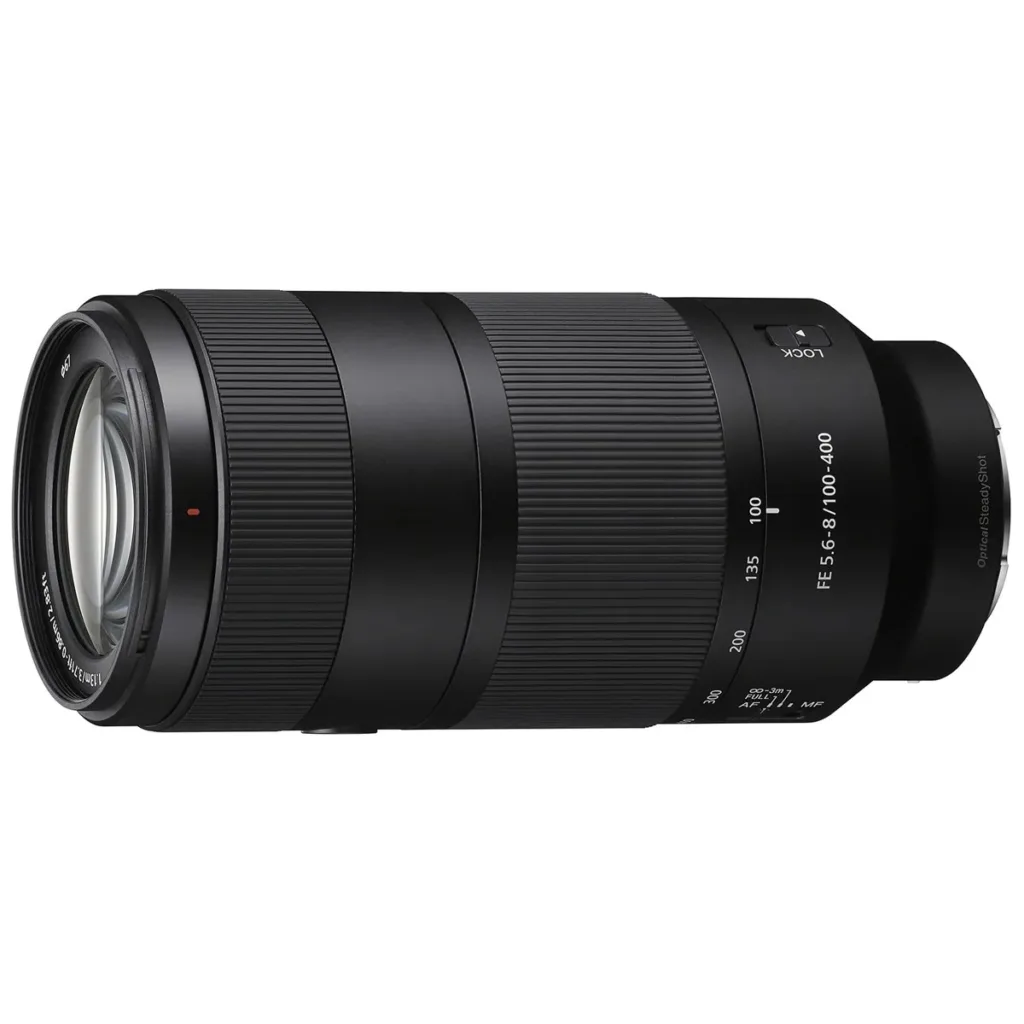
The headline feature is undeniably its physical footprint. Tipping the scales at a mere 654 grams (1.4 lbs), this lens weighs less than half of the G Master 100-400mm. Measuring 78.2mm in diameter by 164.6mm in length and utilizing a modest 67mm filter thread, it fits comfortably into standard daypacks. For backpackers and trail birders who log multiple miles a day, cutting over a pound and a half from your kit is a complete game-changer that reduces shoulder strain and physical fatigue.
2. Macro-Like Close Focus Capability
Beyond long-range tracking, the close-focusing specifications are surprisingly capable. The lens achieves a minimum focus distance of just 0.9 meters (2.8 feet) at the 400mm end, yielding a maximum magnification ratio of 0.41x. In practical trail conditions, this means you don’t need to swap lenses when switching from perched birds to close-up nature subjects like butterflies, dragonflies, or delicate wildflowers along the path.
3. Native Drive Systems and Teleconverters
Under the hood, the optical construction features 15 elements in 10 groups, driven by dual linear motors for silent internal focusing. It includes built-in Optical SteadyShot (OSS) image stabilization to work alongside sensor-shift IBIS. Crucially, Sony preserved full support for the SEL14TC (1.4x) and SEL20TC (2.0x) teleconverters—a feature normally reserved for higher-tier lenses.
Honest Concerns: What I’ll Be Watching For
While the ultra-light design is undeniably attractive on paper, every lens design involves engineering trade-offs. As a birder who values real-world reliability, a few specifications raise crucial questions that can only be answered once production units arrive in the field.
The Low-Light Reality of f/8
The most widely debated spec is the variable aperture ending at f/8 at 400mm. On open beaches, lake margins, or under clear afternoon skies, f/8 is perfectly fine. Modern full-frame sensors handle ISO 1600 to 3200 with ease. However, birding often happens at dawn, dusk, or deep beneath dense forest canopies. In low-light environments, an f/8 aperture restricts light gathering considerably. To maintain the fast shutter speeds required to freeze a songbird’s rapid motion (1/1000s or faster), you will be forced to push ISO levels higher, potentially introducing noise and reducing fine feather detail.
Teleconverter Performance Expectations
While teleconverter support is a huge selling point, the math behind it requires realistic expectations:
- 1.4x Teleconverter: Extends focal reach to 140-560mm, but drops maximum aperture to f/11.
- 2.0x Teleconverter: Extends focal reach to 200-800mm, but drops maximum aperture to f/16.
While recent Sony mirrorless bodies can technically autofocus at f/11 or f/16 under bright sunlight, tracking fast-moving subjects at these narrow apertures will push your camera’s AF system to its limits. Heat haze and atmospheric distortion will also become major factors at extreme focal lengths.
Detailed Technical Specifications Breakdown
When evaluating a newly announced lens on pre-order, the official technical specification sheet tells us precisely how the optic was engineered and where it fits into a birder’s workflow. Below is the complete breakdown of the official specs for the Sony FE 100-400mm f/5.6-8 OSS, along with what each feature means for field performance.
Key Specifications Table
| Feature / Property | Specification Details |
| Lens Mount & Format | Sony E-Mount / Full-Frame |
| Focal Length | 100 to 400mm (150–600mm equivalent on APS-C sensors) |
| Maximum Aperture | f/5.6 (at 100mm) to f/8 (at 400mm) |
| Optical Construction | 15 Elements in 10 Groups (Multi-coated) |
| Aperture Blades | 9-blade circular diaphragm |
| Focusing System | Internal Focus driven by 2 Linear Motors |
| Minimum Focus Distance | 3.7′ (1.1 m) at 100mm — 2.8′ (0.9 m) at 400mm |
| Maximum Magnification | 0.41x |
| Image Stabilization | Optical SteadyShot (OSS) |
| Filter Thread Size | 67 mm (Front) |
| Dimensions (Diameter x Length) | 3.08 x 6.48″ (78.2 x 164.6 mm) |
| Weight | 1.4 lbs (654 g) |
| Weather Protection | Mount rubber sealing ring |
| Included Hood | Round shape, bayonet type (ALC-SH188) |
What These Specifications Mean on the Trail
- Weight & Dimensions (654g / 67mm Filter): Tipping the scales at just 1.4 lbs, it is exceptionally light for a 400mm telephoto zoom. The modest 67mm front filter thread means smaller, cheaper protection filters and a slim profile that packs easily into any daypack.
- Internal Focus & Dual Linear Motors: Because internal focusing moves smaller inner lens elements rather than extending the barrel during focus adjustments, AF responsiveness is fast and quiet—ideal for tracking skittish songbirds without motor noise scaring them off.
- 0.41x Magnification & Close Focus (0.9m): Focusing down to just 2.8 feet at the telephoto end provides impressive close-up capabilities. This allows you to fill the frame with butterflies, dragonflies, or small amphibians when bird activity slows down during midday.
- APS-C Versatility (150–600mm Equivalent): When paired with an APS-C body (like the a6700) or used in Super35 / APS-C crop mode on full-frame vázas, the angle of view narrows to $16^\circ – 4^\circ10’$, giving you a massive 600mm-equivalent reach in a featherweight package.
What the Online Community is Saying
Scanning early pre-order threads across photography forums, Reddit, and wildlife groups reveals a divided yet highly engaged reception. Photographers are quickly splitting into two distinct camps based on their shooting styles:
- The Travel and Hiking Enthusiasts: Backpackers, casual wildlife watchers, and hiking birders are overwhelmingly positive. For this group, a 400mm lens that weighs just 654 grams represents the holy grail of travel gear. Many express excitement over finally having a native 400mm optic that can stay attached to a camera body inside a small shoulder bag during long treks without causing physical discomfort.
- The Low-Light Skeptics: On the other side, seasoned wildlife photographers and early-morning birders express caution regarding the f/8 maximum aperture. They argue that for specialized hides, dense forest tracking, or overcast conditions, the light penalty is too severe compared to heavier f/5.6 or f/6.3 alternatives.
Despite these differing views, the consensus is that Sony intentionally created a specialized tool aimed at mobility rather than trying to replace professional flagship glass.
Final Thoughts on the Pre-Order
The Sony FE 100-400mm f/5.6-8 OSS isn’t meant to replace $2,500+ flagship prime optics or fast f/4 zooms for professional wildlife photographers working in twilight conditions. Instead, it serves a distinct and rapidly growing demographic. It is built for birders, backpackers, and outdoor enthusiasts who prioritize comfort, ease of movement, and native camera performance above all else.
Sony delivers true 400mm super-telephoto reach in a package that weighs just 654 grams (1.4 lbs). In doing so, they have essentially removed the physical and financial barriers to carrying serious glass on long hikes. For years, birding on foot meant making a tough choice. You had to lug a heavy, neck-straining setup like the 200-600mm G, or leave the camera behind entirely. This optic completely changes that equation. It transforms a telephoto setup into an “always-in-the-bag” option. Your shoulders won’t be left aching after an eight-mile trail loop.
The f/8 maximum aperture at the telephoto end requires realistic lighting expectations. Even so, modern mirrorless camera sensors and AI noise-reduction software make that trade-off much easier to manage than it was a decade ago. Do you frequently shoot in open fields, coastlines, or daylight woodland conditions? If so, the portability advantage far outweighs the light penalty for casual use.
Ultimately, this lens represents a smart, practical entry point for anyone looking to step up their wildlife reach without committing to a massive rig. I will be monitoring shipping updates and early hands-on image galleries closely as units begin hitting retail channels!
Over to You
Are you planning to pre-order this ultra-light telephoto, or do you prefer carrying heavier optics to keep a wider maximum aperture? Let’s discuss in the comments below!
Affiliate Disclosure: This post contains affiliate links to retailers like Adorama. If you pre-order or purchase camera gear through these links, GoToBirding may earn a small commission at no additional cost to you. I only recommend gear and pre-order opportunities that provide genuine value to the birding and outdoor community. Thank you for supporting the site!

Lorand Vigh is a nature conservation professional and lifelong birder based in Serbia (Vojvodina). With over 30 years of field experience in birdwatching, habitat protection, and conservation management, he has worked on bird monitoring projects, habitat restoration initiatives, and cross-border conservation cooperation. GoToBirding is a personal project built on real field experience, sharing practical, science-based advice for birders and wildlife photographers.