
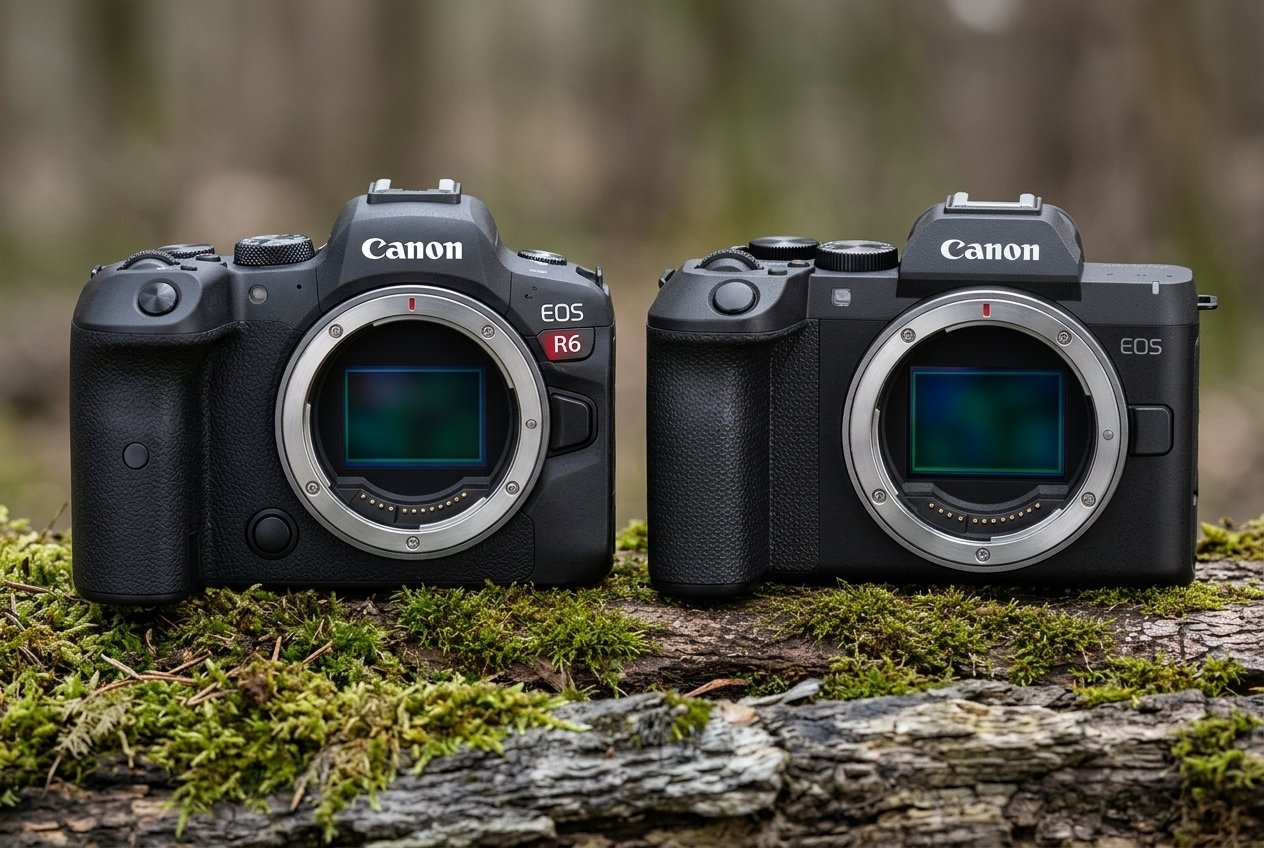
Choosing a camera for bird photography is not simply about buying the model with the highest resolution or the fastest continuous shooting speed. A good wildlife camera needs to do several things well. It should focus reliably on moving subjects, capture fast action, produce detailed images in changing light and work comfortably with long telephoto lenses.
Canon’s EOS R6 Mark III and EOS R8 Mark II approach these requirements from slightly different directions.
The EOS R6 Mark III is the more advanced camera. It combines a 32.5-megapixel full-frame sensor, high-speed shooting, a more capable recording system and two memory card slots. The EOS R8 Mark II is smaller and lighter, but it still offers a 24.2-megapixel full-frame sensor, advanced autofocus and electronic shooting at up to 40 frames per second.
Both cameras look interesting for wildlife photographers, but they are not designed for exactly the same type of user.
I have spent many years photographing nature with Canon equipment, including the EOS 80D. That experience has taught me that the camera body is only one part of the equation. Lens choice, handling, autofocus reliability and the ability to carry the equipment comfortably all matter in the field.
I have not personally tested the EOS R6 Mark III or EOS R8 Mark II, so this comparison is based on Canon’s published specifications and the practical requirements of bird and wildlife photography. Rather than declaring one camera the winner in every situation, I want to look at what each model offers and where its compromises might matter.
Read the full review of the Canon R6 Mark III Mirrorless Camera
Read the full review of the Canon R8 Mark II Mirrorless Camera
Canon EOS R6 Mark III vs EOS R8 Mark II: Key Specifications
Both cameras use full-frame sensors and Canon’s RF lens mount. They also offer 40 fps electronic continuous shooting, subject tracking and in-body image stabilization.
However, there are meaningful differences in resolution, storage, battery system and overall camera design.
| Feature | Canon EOS R6 Mark III | Canon EOS R8 Mark II |
|---|---|---|
| Sensor | 32.5 MP full-frame CMOS | 24.2 MP full-frame CMOS |
| Processor | DIGIC X | DIGIC X |
| Autofocus | Dual Pixel CMOS AF | Dual Pixel CMOS AF II |
| Electronic shutter burst | Up to 40 fps | Up to 40 fps |
| Pre-continuous shooting | Up to 20 frames | Up to 20 frames |
| In-body stabilization | Up to 8.5 stops (center) | Up to 7.5 stops |
| Memory cards | CFexpress Type B + SD UHS-II | Single SD card slot |
| Crop mode | 1.6x | 1.6x |
| Battery | LP-E6P | LP-E17 |
| Weight | Larger professional-style body | Approx. 546 g with battery and card |
| Video | Up to 7K RAW Light | Oversampled 4K up to 60p |
Specifications can vary by shooting mode, lens, market, and testing conditions. Stabilization figures are manufacturer-rated maximums, not guaranteed results in every situation.
1. Sensor Resolution: Is 32.5 MP Better for Bird Photography?
One of the biggest differences between these cameras is resolution.
The EOS R6 Mark III features a 32.5-megapixel full-frame sensor, while the EOS R8 Mark II uses a 24.2-megapixel sensor. That gives the R6 Mark III a noticeable advantage in the number of pixels available for cropping.
Why does this matter for bird photography?
Birds are not always close. Even with a long telephoto lens, there will be situations when the subject occupies only a small part of the frame. This is particularly common when photographing small woodland birds, waders or birds in open habitats.
A higher-resolution sensor gives you more room to crop while retaining detail. It can be useful when you cannot move closer or when changing your position would disturb the subject.
The R6 Mark III also offers a 1.6x crop shooting option. Its resulting image is approximately 12.4 megapixels. The R8 Mark II offers the same crop factor, but its cropped image is approximately 9.3 megapixels.
That difference may become relevant when you regularly crop your wildlife photographs.
However, megapixels are not everything. A sharp image from a 24.2 MP sensor can be more useful than a poorly focused image from a 32.5 MP sensor. Lens quality, shutter speed, atmospheric conditions, focus accuracy and technique all have a major influence on the final result.
My take: For photographers who regularly crop distant birds, the R6 Mark III has the more attractive sensor. The R8 Mark II still provides enough resolution for many everyday wildlife photographs, especially when paired with a suitable telephoto lens.
2. Autofocus: An Important Feature for Birds in Motion
Autofocus is one of the most important features in a bird photography camera.
A perched bird is relatively easy to photograph compared with a swallow flying across the sky or a small bird moving quickly between branches. In those situations, the camera needs to recognize the subject, maintain focus and respond quickly when its movement changes.
The EOS R6 Mark III uses Canon’s Dual Pixel CMOS AF system, with subject tracking and improved focusing algorithms. The EOS R8 Mark II features Dual Pixel CMOS AF II, with tracking for people, animals and vehicles across the frame.
Both cameras offer advanced autofocus capabilities, but specifications alone cannot tell the whole story.
For bird photography, I would pay particular attention to:
- How consistently the camera detects birds against complicated backgrounds.
- Whether it maintains focus when branches or vegetation pass in front of the subject.
- How well it follows birds approaching or moving across the frame.
- How easily the photographer can select or change the subject.
- How reliable tracking remains in difficult light.
Canon’s published specifications are a useful starting point, but actual field tests are needed to establish how the two cameras compare in demanding wildlife situations.
My take: I would not choose between these cameras based on autofocus marketing alone. Both have modern tracking systems. Independent bird photography tests will be more revealing than simply comparing their advertised autofocus features.
3. Continuous Shooting: Both Cameras Can Reach 40 fps
Fast continuous shooting is particularly useful when photographing birds in flight, take-offs, landings and other brief moments.
The good news is that both cameras can shoot at up to 40 frames per second using the electronic shutter. Both also support pre-continuous shooting, allowing the camera to record up to 20 frames before the shutter button is fully pressed.
This feature can be valuable when photographing unpredictable behaviour. A bird may take off before you have time to react, or a short interaction may happen in a fraction of a second.
However, maximum frame rate is only one part of the picture.
The camera must also maintain focus, manage its buffer and write images to the memory card. Shooting at 40 fps can quickly create large numbers of files, especially when using RAW format.
The R6 Mark III has an important advantage here: its CFexpress Type B and SD UHS-II card slots provide a more flexible recording setup. Canon also specifies a large RAW burst capacity when using a suitable CFexpress card.
The R8 Mark II has a single SD card slot. That is simpler and less expensive, but it offers fewer options for demanding shooting sessions and no second card for simultaneous backup.
My take: Both cameras offer impressive headline shooting speeds. For longer action sequences and demanding wildlife work, I would give the R6 Mark III the advantage because of its more capable storage setup.
4. Image Stabilization: Helpful, but Not a Replacement for Shutter Speed
Image stabilization is useful when photographing wildlife, particularly when carrying a camera and telephoto lens for extended periods.
The EOS R6 Mark III offers up to 8.5 stops of coordinated image stabilization under Canon’s specified test conditions. The EOS R8 Mark II offers up to 7.5 stops.
These are maximum manufacturer figures. Actual performance depends on the lens, focal length, shooting conditions and stabilization settings.
For bird photography, there is one important point to remember: stabilization helps reduce camera movement, but it does not freeze a moving bird.
A fast shutter speed is still necessary for sharp photographs of birds in flight or active subjects. Image stabilization is more useful when photographing stationary birds, especially in low light, or when composing handheld images with a long lens.
The R6 Mark III has a small advantage on paper, but I would not make the camera decision based on one stop of claimed stabilization alone.
5. Handling and Portability: The R8 Mark II Has a Clear Advantage
Camera weight and handling become increasingly important when spending several hours outdoors.
Bird photographers often carry a camera with a telephoto lens, spare batteries, memory cards, binoculars and other field equipment. A lighter setup can make a real difference on a long walk.
The EOS R8 Mark II weighs approximately 546 grams with its battery and memory card installed. It is designed as a compact full-frame camera with a relatively small body.
The EOS R6 Mark III belongs to a more advanced camera category, with a larger body and a more substantial control layout.
There are advantages to both approaches.
A compact camera is easier to carry, particularly when travelling or walking long distances. However, a larger body can offer more comfortable handling with heavier telephoto lenses, more direct controls and a battery system better suited to extended shooting.
This is worth considering before choosing a camera for wildlife photography. A small camera body does not necessarily make a complete bird photography setup lightweight. A large telephoto lens will still account for much of the total weight.
My take: The R8 Mark II is attractive for photographers who value portability. The R6 Mark III looks like the more practical choice for extended and demanding shooting sessions, particularly when paired with larger lenses.
6. Battery Life and Memory Cards
Battery performance is easy to overlook when comparing cameras, but it matters in the field.
The EOS R6 Mark III uses the LP-E6P battery family, while the EOS R8 Mark II uses the smaller LP-E17 battery.
This is an important practical distinction. The R8 Mark II’s compact design comes with a smaller battery, so carrying a spare is sensible for longer birding trips.
Memory card arrangements are another major difference.
The R6 Mark III has two card slots:
- One CFexpress Type B slot.
- One SD UHS-II slot.
The R8 Mark II has a single SD card slot.
For casual photography, one SD card may be perfectly adequate. For more demanding wildlife work, two card slots provide additional flexibility. They can also be configured for simultaneous recording, depending on the selected settings.
If you photograph important moments or spend a long time away from a computer, having a second recording card can provide extra peace of mind.
My take: This is one of the strongest reasons to choose the R6 Mark III. Its dual-card arrangement and larger battery system make it a more suitable camera for photographers who regularly spend long days in the field.
7. Which Camera Is Better for Wildlife Lenses?
A camera body is only part of a wildlife photography system. The lens often has an even greater influence on what you can photograph.
Both cameras use Canon’s RF mount and can also work with compatible EF and EF-S lenses through the EF-EOS R adapter.
For bird photography, I would consider lenses such as:
- Canon RF 100-400mm F5.6-8 IS USM: A relatively lightweight and accessible telephoto option.
- Canon RF 100-500mm F4.5-7.1 L IS USM: A more advanced and versatile wildlife zoom.
- Canon RF 200-800mm F6.3-9 IS USM: Particularly interesting for distant wildlife and smaller birds.
- Canon RF 600mm and 800mm prime lenses: Options for photographers who need longer focal lengths.
The choice depends on the type of birds you photograph, your budget and how much equipment you are comfortable carrying.
It is also worth remembering that both cameras have full-frame sensors. They do not provide the same field of view as an APS-C camera when using the same lens. The R6 Mark III’s higher resolution gives it more flexibility for cropping, but it does not physically extend the focal length of the lens.
For anyone moving from a Canon APS-C camera such as the EOS 80D, this is an important point to consider before investing in a full-frame body.
8. Price and Overall Value
The EOS R6 Mark III sits in a higher camera category, while the EOS R8 Mark II is positioned as a more accessible full-frame option.
At launch in the United States, Canon listed the R6 Mark III body at an estimated retail price of $2,799 and the R8 Mark II body at $1,899. Actual prices vary by country, retailer, promotions, and availability.
That price difference is significant, especially when you consider the additional cost of wildlife lenses, memory cards, spare batteries and other accessories.
The R8 Mark II could leave more room in the budget for a better telephoto lens. For bird photography, that may be a smarter investment than spending everything on the camera body.
On the other hand, the R6 Mark III offers more resolution, a more advanced storage arrangement and a stronger overall specification for demanding work.
I would not automatically recommend the more expensive camera to every wildlife photographer. The best value depends on how often you photograph birds, how demanding your subjects are and what equipment you already own.
Canon EOS R6 Mark III vs EOS R8 Mark II: Pros and Cons
Canon EOS R6 Mark III
Pros
- Higher-resolution 32.5 MP full-frame sensor.
- More flexibility when cropping distant wildlife photographs.
- Up to 40 fps electronic continuous shooting.
- Pre-continuous shooting.
- Up to 8.5 stops of rated coordinated image stabilization.
- Dual memory card slots, including CFexpress Type B.
- More advanced recording and video capabilities.
- Larger battery system.
Cons
- Higher purchase price.
- Larger and heavier camera body.
- CFexpress cards add to the overall system cost.
- May offer more features than some casual wildlife photographers need.
Canon EOS R8 Mark II
Pros
- Compact full-frame camera body.
- Approx. 546 g with battery and memory card.
- 24.2 MP full-frame sensor.
- Up to 40 fps electronic continuous shooting.
- Pre-continuous shooting.
- Up to 7.5 stops of rated image stabilization.
- Advanced animal and subject tracking.
- Lower launch price than the R6 Mark III.
Cons
- Lower resolution, with less room for heavy cropping.
- Single SD card slot.
- Smaller LP-E17 battery.
- Less flexible recording setup.
- Compact body may be less comfortable with large telephoto lenses.
Which Canon Camera Should Bird Photographers Choose?
There is no universal answer. Both cameras have features that could make them useful for bird and wildlife photography, but they suit different priorities.
Choose the Canon EOS R6 Mark III if:
- You regularly photograph birds in flight and fast-moving wildlife.
- You often crop images of distant or small birds.
- You want more resolution without moving to a higher-resolution camera category.
- You value dual card slots and a larger battery system.
- You spend long periods photographing wildlife and need a more advanced camera body.
Choose the Canon EOS R8 Mark II if:
- You want a compact full-frame camera.
- You value portability during long walks and travel.
- You mainly photograph perched birds, landscapes and general wildlife.
- You want modern autofocus and fast electronic shooting without paying for every professional feature.
- You would rather invest more of your budget in a good telephoto lens.
For many photographers, the R8 Mark II could be a sensible entry into full-frame wildlife photography. The R6 Mark III is the more complete option for photographers who regularly work in demanding conditions and want greater flexibility.
Final Thoughts: The Camera Is Only Part of the Equation
I have always believed that good wildlife photography is about more than owning the newest camera. Knowing your subject, understanding its behaviour, choosing the right moment and being patient are just as important.
After many years with Canon cameras, including the EOS 80D, I have learned to look beyond impressive specifications. A camera needs to feel comfortable in the field, work reliably and suit the way you actually photograph wildlife.
The EOS R6 Mark III is the more capable all-round camera on paper. Its higher resolution, dual card slots and larger battery system make it an appealing choice for serious bird photographers.
The EOS R8 Mark II is a different proposition. It offers a modern full-frame sensor, advanced autofocus, fast continuous shooting and image stabilization in a much more compact package. For photographers who value portability and do not need every professional feature, that combination could be very attractive.
If I were choosing between these two cameras specifically for bird photography, I would lean towards the R6 Mark III for its extra cropping flexibility and more complete shooting setup. However, I would also consider the money saved with the R8 Mark II and whether it could be put towards a longer or better telephoto lens.
That is often the more important decision: a balanced camera-and-lens combination can be more useful in the field than an expensive camera body paired with a lens that does not provide enough reach.
Ultimately, choose the camera that supports the way you enjoy photographing birds. The best equipment is the equipment that helps you spend more time observing, learning and capturing the natural world.
Frequently Asked Questions
Is the Canon EOS R6 Mark III better than the EOS R8 Mark II for bird photography?
The R6 Mark III has several advantages, including a higher-resolution sensor, dual card slots and a larger battery system. The R8 Mark II is lighter and less expensive, while still offering 40 fps electronic shooting and advanced autofocus. The better choice depends on your shooting style and budget.
Which camera has better image quality?
The R6 Mark III has a 32.5 MP sensor, compared with 24.2 MP in the R8 Mark II. This gives it more cropping flexibility. However, image quality also depends on the lens, exposure, focus accuracy and shooting conditions.
Are both cameras suitable for birds in flight?
Both offer electronic continuous shooting at up to 40 fps and advanced subject tracking. These specifications make them interesting options for birds in flight. Real-world autofocus tracking performance should still be considered when choosing between them.
Does the Canon EOS R8 Mark II have in-body image stabilization?
Yes. The EOS R8 Mark II includes five-axis in-body image stabilization. Canon rates its stabilization performance at up to 7.5 stops under specified conditions.
Can I use my existing Canon EF lenses?
Yes. Compatible EF and EF-S lenses can be used on both cameras with the Canon EF-EOS R mount adapter. This can make upgrading to the RF system easier for existing Canon DSLR users.
Which camera is better for beginners in wildlife photography?
The R8 Mark II may be the more accessible starting point because of its smaller body and lower launch price. However, beginners should also consider investing in an appropriate telephoto lens and learning how to use autofocus, shutter speed and exposure effectively.
Affiliate Disclosure: This article may contain affiliate links. If you purchase through one of these links, GoToBirding may earn a small commission at no additional cost to you. This helps support the website and its independent birding and wildlife photography content. No brand has paid for this comparison or influenced its conclusions.
Editorial note: This comparison is based on published manufacturer specifications and available product information. The author has not personally tested the EOS R6 Mark III or EOS R8 Mark II. Specifications, prices and availability may change.
Lorand Vigh is a nature conservation professional and lifelong birder based in Serbia (Vojvodina). With over 30 years of field experience in birdwatching, habitat protection, and conservation management, he has worked on bird monitoring projects, habitat restoration initiatives, and cross-border conservation cooperation. GoToBirding is a personal project built on real field experience, sharing practical, science-based advice for birders and wildlife photographers.