
After more than 30 years of birding and spending a considerable amount of time photographing wildlife and nature, I have learned that choosing camera equipment is not simply about buying the longest lens or the most expensive camera body. The best equipment is the equipment that works in the field, fits your needs, and makes you want to take your camera along.
Bird photography has always been particularly demanding. Small birds can be difficult to approach, wildlife does not wait for the perfect moment, and changing light conditions can make an otherwise excellent photograph challenging. A good camera and telephoto lens can make a significant difference, but they are only part of the picture.
I also want a camera system that does not become limited to wildlife photography. Family photographs, outdoor activities, landscapes, travel and sports are all situations where a versatile camera can be useful. I do not want to carry several lenses that offer almost the same focal-length range, nor do I want to invest in expensive equipment that spends most of its time in a camera bag.
That is why I would build a Canon RF system around two complementary zoom lenses. One would handle birds, wildlife and outdoor action, while the other would cover everyday photography. Additional lenses would come later, but only when there is a clear reason to buy them.
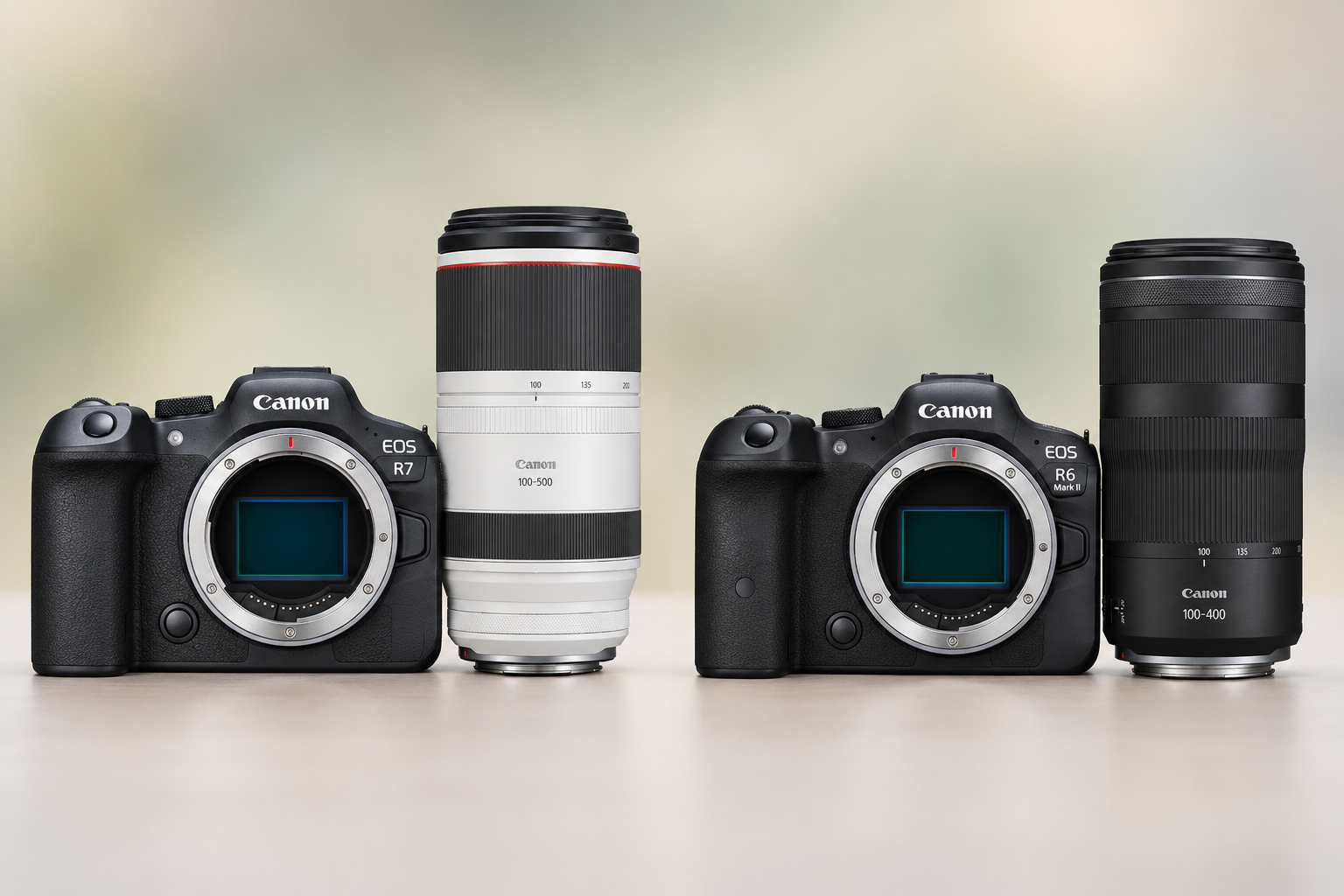
Two Canon mirrorless cameras stand out as starting points for this type of system: the EOS R7 and the EOS R6 Mark II. Both offer capable autofocus, modern subject detection and access to Canon’s growing RF lens range. However, their different sensor formats make them suitable for slightly different photographic priorities.
In this guide, I will compare the two camera bodies, look at the most useful lens combinations and explain where I would invest first to build a practical system without unnecessary duplication.
1. Choosing the Camera Body: Canon EOS R7 or EOS R6 Mark II?
The first decision is whether to choose an APS-C or full-frame camera. This is more important than it might initially appear because sensor size influences field of view, cropping flexibility, low-light performance and the way different lenses work together.
The Canon EOS R7 and EOS R6 Mark II are both capable cameras, but they approach photography from different directions.
The R7 has a 32.5-megapixel APS-C sensor. Its smaller sensor gives a 1.6× crop factor, which is particularly useful when photographing distant birds and wildlife. It also provides a high pixel density, allowing photographers to retain considerable detail when cropping an image.
The R6 Mark II has a 24.2-megapixel full-frame sensor. It offers a wider field of view with the same lens and generally better high-ISO performance, making it attractive for indoor photography, family events, portraits and situations where light is limited.
It is important to understand that the crop factor does not physically increase a lens’s focal length. A 400mm lens remains a 400mm lens, but the R7 records a smaller portion of the projected image, producing a tighter field of view.
For example, a 400mm lens on the R7 provides approximately the same field of view as a 640mm lens on a full-frame camera. This can be a real advantage when photographing small or distant birds.
Canon EOS R7 – A wildlife and bird photography specialist
The Canon EOS R7 is particularly interesting for photographers who regularly photograph birds, wildlife and outdoor sports. Its combination of resolution, APS-C sensor and subject detection makes it a strong option for capturing distant subjects.
The 32.5-megapixel resolution is one of its biggest advantages. When photographing a small bird sitting high in a tree or moving through vegetation, getting close is not always possible. Having more pixels across the subject can provide additional flexibility when composing and cropping the final image.
The camera also offers impressive continuous shooting capabilities, with mechanical shooting up to 15 frames per second and electronic shooting up to 30 frames per second. These speeds can be useful for birds in flight and fast-moving outdoor subjects.
The main compromise is low-light performance. While the R7 is perfectly capable in challenging conditions, its smaller sensor generally produces more visible noise at higher ISO settings than the R6 Mark II, particularly when comparing images at the same output size.
What makes the R7 attractive:
- 32.5-megapixel APS-C sensor with high pixel density.
- 1.6× crop factor for a tighter field of view.
- Up to 15 fps mechanical and 30 fps electronic shooting.
- Animal subject detection and Dual Pixel CMOS AF.
- In-body image stabilization.
- Two UHS-II SD card slots.
For someone whose main photographic interest is birds and wildlife, the R7 is a very logical starting point.
Read full review of the Canon EOS R7 Mirrorless Camera.
Canon EOS R6 Mark II – A more versatile full-frame option
The EOS R6 Mark II is a different proposition. Its 24.2-megapixel full-frame sensor offers a wider field of view and stronger high-ISO performance, making it a particularly attractive camera for photographers who regularly move between different subjects.
For family photography, portraits, indoor events and outdoor activities, the full-frame sensor provides considerable flexibility. It is also useful when photographing wildlife in woodland or during early morning and evening light, although the lens aperture and shutter speed remain important.
The R6 Mark II offers up to 12 fps mechanical shooting and 40 fps electronic shooting. Its autofocus system includes animal detection, making it capable of tracking birds and other wildlife.
The main disadvantage for distant bird photography is its lower pixel density compared with the R7. When using the same telephoto lens and photographing the same distant subject, the R7 will generally place more pixels across that subject.
This does not mean the R6 Mark II cannot produce excellent wildlife photographs. It simply means that photographers who frequently crop heavily may find the R7 more advantageous.
What makes the R6 Mark II attractive:
- 24.2-megapixel full-frame sensor.
- Strong high-ISO performance.
- Excellent subject detection and autofocus.
- Up to 12 fps mechanical and 40 fps electronic shooting.
- In-body image stabilization.
- Two UHS-II SD card slots.
For someone who wants one camera to cover wildlife, family photography, travel and indoor activities, the R6 Mark II is a very compelling option.
Read full review of the Canon EOS R6 Mark II Mirrorless Camera.
Canon EOS R7 vs EOS R6 Mark II: Specifications
| Sensor format | APS-C CMOS | Full-frame CMOS |
| Effective resolution | 32.5 MP | 24.2 MP |
| Crop factor | 1.6× | 1.0× |
| Mechanical shutter burst | Up to 15 fps | Up to 12 fps |
| Electronic shutter burst | Up to 30 fps | Up to 40 fps |
| Autofocus | Dual Pixel CMOS AF II | Dual Pixel CMOS AF II |
| Subject detection | People, animals, vehicles | People, animals, vehicles |
| Viewfinder | 2.36-million-dot EVF | 3.69-million-dot EVF |
| Memory cards | 2× SD UHS-II | 2× SD UHS-II |
| Image stabilization | 5-axis IBIS | 5-axis IBIS |
Continuous shooting rates are maximum figures under specified conditions. Actual performance can vary with shutter mode, subject, battery condition, card and camera settings. Stabilization performance also depends on the lens and shooting conditions.
My choice would depend on the balance between wildlife and other types of photography. If I photographed birds most frequently, I would lean towards the R7. If I wanted a more general-purpose camera with better flexibility in low light, the R6 Mark II would deserve serious consideration.
2. The Main Telephoto Lens: Canon RF 100-400mm or RF 100-500mm L?
For a wildlife-oriented camera system, the telephoto lens is probably the most important purchase after the camera body.
A standard zoom can handle many everyday situations, but it cannot replace the reach needed for small birds, distant wildlife or outdoor sports. Canon offers two particularly interesting RF zoom lenses for this purpose: the RF 100-400mm F5.6-8 IS USM and the RF 100-500mm F4.5-7.1 L IS USM.
Both cover a useful focal-length range, but they have different strengths. The 100-400mm focuses on portability and affordability, while the 100-500mm L offers more reach, premium construction and a more advanced optical design.
Canon RF 100-400mm F5.6-8 IS USM – A practical telephoto for everyday wildlife photography
The RF 100-400mm is one of the most attractive entry points into Canon’s RF telephoto range. It is relatively lightweight, compact and considerably easier to carry than many traditional super-telephoto lenses.
For bird photography, the 400mm maximum focal length is useful, especially when paired with the EOS R7. The combination provides a field of view equivalent to approximately 160-640mm on a full-frame camera.
This makes it a practical option for photographing birds in open landscapes, garden wildlife, larger mammals and outdoor sports.
The lens also has a useful minimum focusing distance, reaching 0.88m at 200mm. This provides some flexibility when photographing closer subjects.
Its biggest limitation is the maximum aperture. At 400mm, the lens is f/8, which can be restrictive when photographing birds in woodland, during overcast weather or in the early morning.
However, this is not necessarily a reason to dismiss it. Good light, appropriate shutter speeds and careful exposure can produce very satisfying results.
Another interesting feature is compatibility with Canon’s RF 1.4× and 2× extenders. These increase the focal length but also reduce the maximum available aperture. With the 1.4× extender, the lens becomes a 140-560mm f/8-11 combination. With the 2× extender, it becomes a 200-800mm f/11-16 combination.
Although this provides additional reach, the reduced light transmission makes these combinations more demanding, particularly for moving birds and low-light photography.
Main advantages:
- Relatively affordable compared with L-series telephoto lenses.
- Lightweight construction at approximately 635g.
- Useful 100-400mm focal-length range.
- Optical image stabilization rated up to 5.5 stops.
- Compatible with Canon RF 1.4× and 2× extenders.
- A practical companion for the EOS R7.
Canon RF 100-500mm F4.5-7.1 L IS USM – A more serious long-term investment
The RF 100-500mm L is a more advanced option for photographers who want additional reach and premium construction.
The extra 100mm might not seem particularly significant on paper, but for bird photography it can be useful. Small birds are often difficult to approach, and even a modest increase in focal length can help fill more of the frame.
On the EOS R7, the lens provides a field of view equivalent to approximately 160-800mm on a full-frame camera. This makes it a particularly attractive combination for wildlife photography.
The lens also offers L-series construction, weather resistance, advanced optical elements and a more sophisticated focusing system. Its image stabilization is rated up to five stops under Canon’s specified testing conditions.
Compared with the 100-400mm, however, it is substantially heavier. At approximately 1,370g without the tripod socket, it is more than twice the weight of the smaller lens.
This is an important consideration for photographers who spend long hours walking outdoors.
The 100-500mm also supports Canon’s RF 1.4× and 2× extenders, but there is a restriction: the extenders can only be used when the zoom is set between 300mm and 500mm. This is an important detail to remember when considering the additional cost of an extender.
Main advantages:
- Extended 100-500mm focal-length range.
- L-series optical construction.
- Weather-resistant design.
- Optical image stabilization rated up to five stops.
- Compatible with Canon RF 1.4× and 2× extenders, with zoom-range restrictions.
- Excellent versatility for wildlife, birds and outdoor sports.
Read full review of the Canon RF 100-500mm Lens.
RF 100-400mm vs RF 100-500mm L: Specifications
| Specification | RF 100-400mm | RF 100-500mm L |
|---|---|---|
| Focal length | 100-400mm | 100-500mm |
| Maximum aperture | f/5.6-8 | f/4.5-7.1 |
| Optical stabilization | Up to 5.5 stops | Up to 5 stops |
| Weight without tripod collar | Approx. 635g | Approx. 1,370g |
| Filter diameter | 67mm | 77mm |
| Minimum focusing distance | 0.88m at 200mm | 0.9m at 100mm |
| Maximum magnification | 0.41× | 0.33× |
| RF 1.4× extender | Compatible | Compatible, 300-500mm only |
| RF 2× extender | Compatible | Compatible, 300-500mm only |
| Construction | Standard RF | L-series, weather-resistant |
The stabilization figures are based on Canon’s published CIPA testing. Actual performance depends on the camera body, focal length and shooting technique.
Which telephoto would I choose?
The RF 100-400mm is the sensible choice when budget, portability and daylight photography are the priorities. It is capable of covering a wide range of wildlife situations without requiring a major investment.
The RF 100-500mm L is the more ambitious choice. If bird photography is the main reason for buying the camera and the budget allows, I would seriously consider it as a long-term lens.
I would not buy both. Their focal-length ranges overlap considerably, and the money saved by choosing one can be invested in a better camera body, a standard zoom or other useful equipment.
Read my full review on the 5 Best Canon RF Telephoto Lenses for Wildlife Photography
3. The Everyday Zoom: A Lens for Family, Travel and Outdoor Photography
A telephoto lens is essential for distant wildlife, but it is not the lens I would want to use for every situation.
Family photographs, landscapes, travel, architecture and everyday outdoor activities often require a wider field of view. This is where a standard zoom becomes important.
The choice depends on which camera body you select.
Canon RF-S 18-150mm F3.5-6.3 IS STM – A natural companion for the EOS R7
The RF-S 18-150mm is one of the most versatile everyday lenses available for the R7.
Its focal-length range is equivalent to approximately 29-240mm on a full-frame camera. This provides a useful combination of wide-angle coverage and short telephoto reach.
For family outings, travel, landscapes and casual portraits, it can handle a surprising number of situations. It also has optical image stabilization and a relatively lightweight construction.
I particularly like the idea of combining this lens with the RF 100-400mm. The two lenses have clearly defined roles: the 18-150mm handles everyday photography, while the 100-400mm is reserved for birds, wildlife and more distant subjects.
This avoids the need for another standard or medium telephoto zoom.
Main advantages:
- Broad 18-150mm focal-length range.
- Lightweight construction at approximately 310g.
- Optical image stabilization.
- Useful for family photography, travel and landscapes.
- Excellent complement to a dedicated wildlife telephoto.
Canon RF 24-105mm F4-7.1 IS STM – An affordable full-frame standard zoom
For the EOS R6 Mark II, the RF 24-105mm F4-7.1 IS STM is a sensible everyday option.
It covers a useful range from moderate wide-angle to short telephoto, making it suitable for family photographs, landscapes, travel and general outdoor photography.
It is also relatively lightweight, which helps keep the overall camera system manageable.
The main compromise is its variable maximum aperture. At the long end, f/7.1 is not particularly bright, so it is not the best choice for demanding indoor situations or very low light.
However, for general photography in reasonable lighting conditions, it is a practical and affordable lens.
Canon RF 24-105mm F4 L IS USM – A more advanced alternative
Photographers who want better low-light flexibility and a more premium standard zoom should consider the RF 24-105mm F4 L IS USM.
Its constant f/4 aperture is particularly useful because it remains available throughout the zoom range. This makes exposure more predictable when changing focal lengths.
The lens also offers L-series construction, weather resistance and optical image stabilization.
The disadvantages are its higher price and greater weight. At approximately 700g, it is considerably heavier than the STM version.
I would choose it if family photography, travel and general-purpose shooting were major parts of my photography and I wanted a more advanced standard zoom.
Everyday zoom specifications
| Specification | RF-S 18-150mm | RF 24-105mm STM | RF 24-105mm F4 L |
|---|---|---|---|
| Sensor format | APS-C | Full frame | Full frame |
| Focal length | 18-150mm | 24-105mm | 24-105mm |
| Maximum aperture | f/3.5-6.3 | f/4-7.1 | Constant f/4 |
| Image stabilization | Yes | Yes | Yes |
| Weight | Approx. 310g | Approx. 395g | Approx. 700g |
| Filter diameter | 55mm | 67mm | 77mm |
| Weather resistance | No L-series sealing | No L-series sealing | Yes |
One important compatibility detail deserves attention. The RF-S 18-150mm is designed for APS-C cameras. It can physically be mounted on the R6 Mark II, but the camera automatically switches to its 1.6× crop mode. This reduces the usable resolution of the 24.2-megapixel full-frame sensor to approximately 9.4 megapixels.
For that reason, I would not recommend the RF-S 18-150mm as the everyday lens for the R6 Mark II. The RF 24-105mm is a much more appropriate choice.
4. Two Complete Canon RF Kits Worth Considering
After comparing the cameras and lenses individually, the next step is to put together a system that works as a whole.
I would start with two lenses rather than three or four. The objective is to cover the most important photographic situations without buying equipment that performs almost the same job.
Kit A: Canon EOS R7 – Wildlife and Bird Photography First
| Component | Recommended equipment |
|---|---|
| Camera body | Canon EOS R7 |
| Main telephoto | RF 100-400mm F5.6-8 IS USM |
| Everyday zoom | RF-S 18-150mm F3.5-6.3 IS STM |
This is the combination I would choose for someone whose main photographic interest is birds, wildlife and outdoor sports.
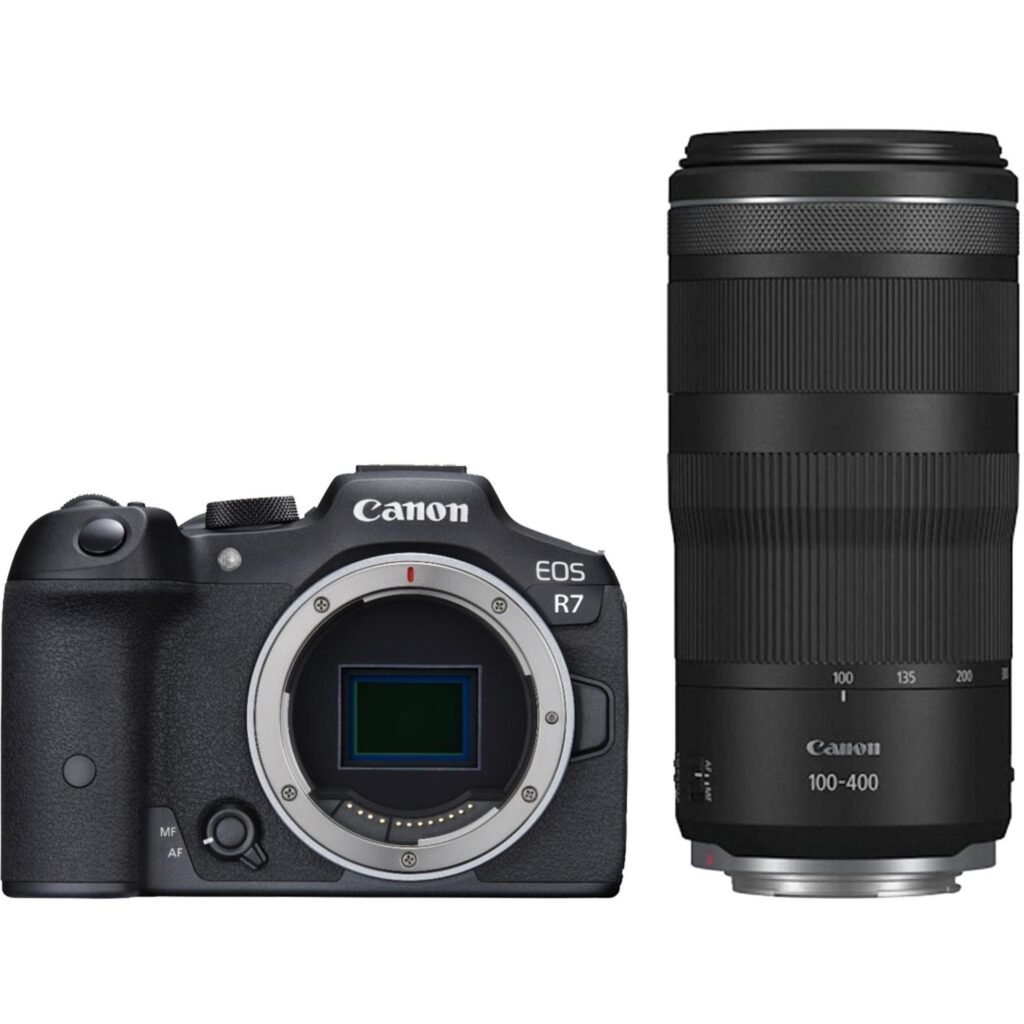
The R7’s APS-C sensor provides a tighter field of view with the telephoto lens, while the 32.5-megapixel resolution offers useful cropping flexibility.
The RF 100-400mm provides the reach needed for most everyday wildlife photography, particularly in good light. The RF-S 18-150mm handles everything else, from family photographs to landscapes and travel.
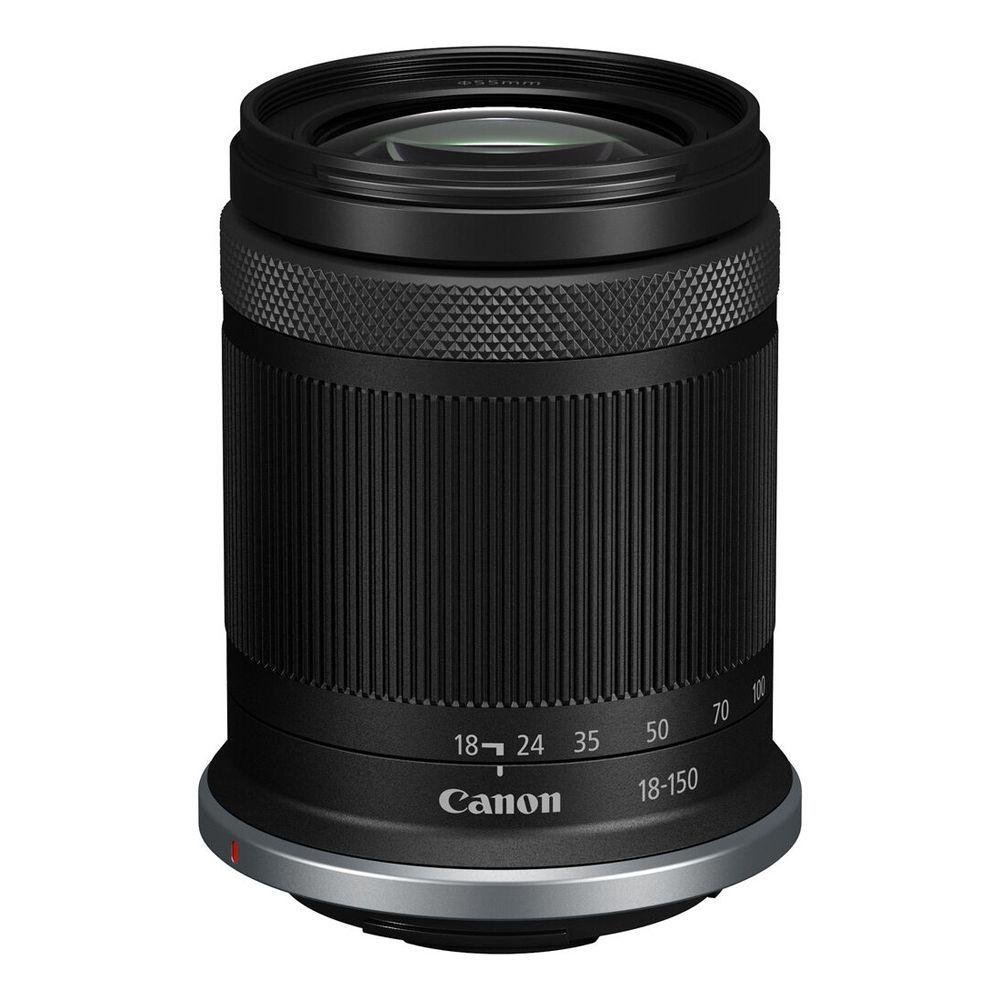
There is little reason to add another general-purpose zoom immediately. The two lenses already cover a broad range of situations.
If the budget allows, I would consider replacing the RF 100-400mm with the RF 100-500mm L. This provides an additional 100mm of reach, more advanced construction, and a premium optical design.
This kit is particularly suitable for:
- Bird photography and garden wildlife.
- Wildlife photography in good light.
- Outdoor sports and action.
- Nature walks and travel.
- Family photography and everyday situations.
The main compromise is low-light performance, particularly when using the RF 100-400mm at its maximum focal length.
Kit B: Canon EOS R6 Mark II – A Balanced Full-Frame System
| Component | Recommended equipment |
|---|---|
| Camera body | Canon EOS R6 Mark II |
| Main telephoto | RF 100-500mm F4.5-7.1 L IS USM |
| Everyday zoom | RF 24-105mm F4-7.1 IS STM |
This is the combination I would consider for someone who wants a more balanced camera system.
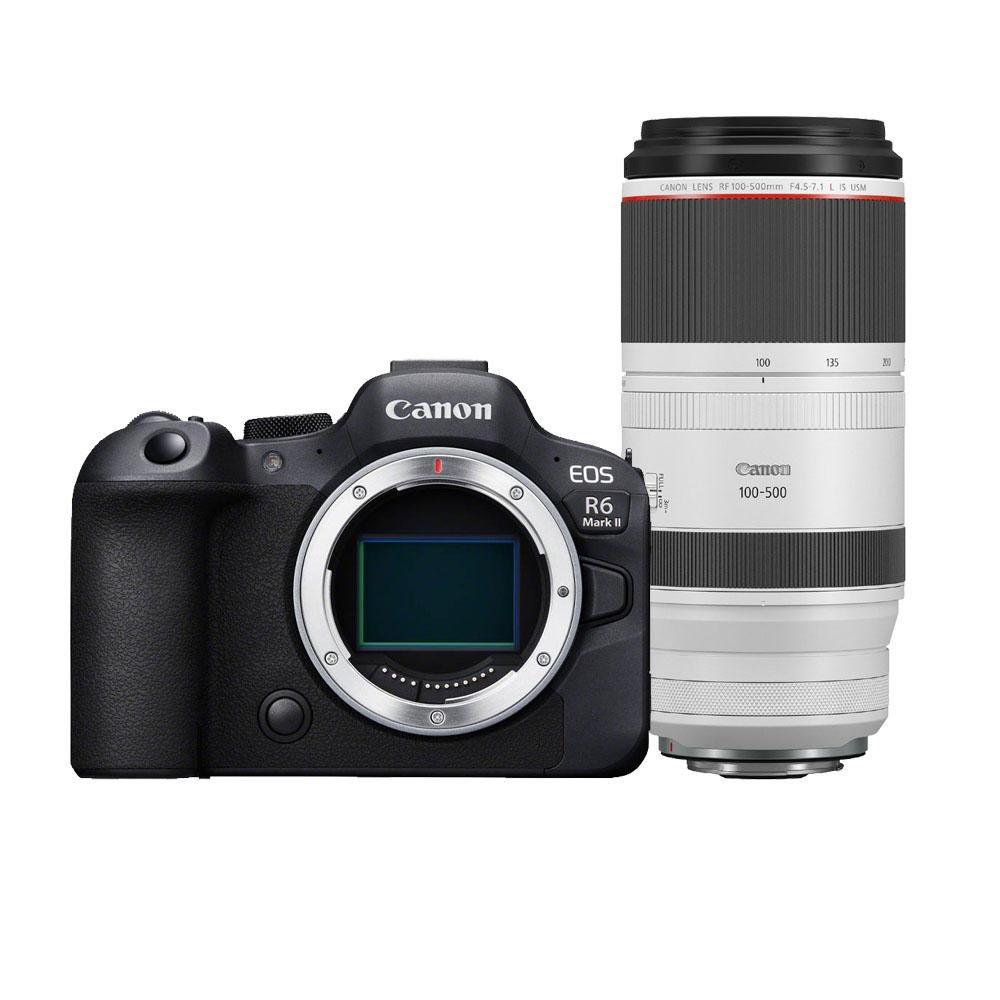
The R6 Mark II provides full-frame flexibility for family photographs, landscapes, portraits and indoor situations. Its high-ISO performance is also useful when photographing wildlife in difficult lighting conditions.
The RF 100-500mm takes care of birds, wildlife and outdoor sports, while the RF 24-105mm covers the majority of everyday photographic situations.
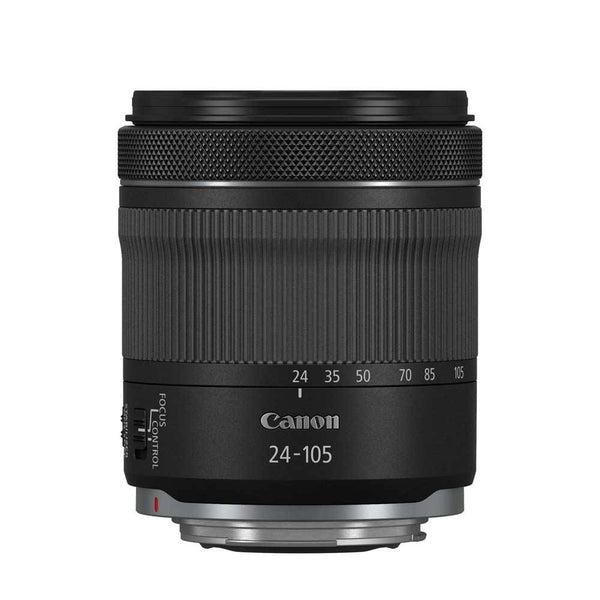
One of the biggest advantages of this combination is that each lens has a clear purpose. There is no immediate need to purchase another zoom simply to fill a small gap in the focal-length range.
If the budget allows, the RF 24-105mm F4 L IS USM is an attractive alternative to the STM version, especially if you frequently photograph indoors or prefer a constant aperture.
This kit is particularly suitable for:
- A mixture of bird and wildlife photography.
- Family photography and portraits.
- Outdoor sports and general action.
- Travel and landscapes.
- Photography in changing lighting conditions.
The main compromise is that the R6 Mark II does not provide the same pixel density for distant birds as the R7.
5. Which Additional Lenses Are Worth Considering Later?
One of the easiest ways to spend more than necessary when building a camera system is to buy lenses before identifying what is actually missing.
Canon’s RF range includes several excellent lenses, but not every photographer needs all of them.
With a 100-400mm or 100-500mm telephoto and a suitable standard zoom, the most important photographic situations are already covered.
Additional lenses should solve a specific problem rather than simply increase the size of the equipment collection.
Canon RF70-200mm F2.8 L is USM Lens
The RF 70-200mm range is particularly interesting for sports, portraits and indoor photography.
The faster f/2.8 version is attractive when photographing indoor events, performances or sports where light is limited. The f/4 version is lighter and more compact.
However, if the main telephoto is already a 100-400mm or 100-500mm, there is substantial focal-length overlap.
I would only add a 70-200mm when the faster aperture or handling characteristics provide a genuine advantage.
Canon RF 200-800mm F6.3-9 IS USM
For dedicated wildlife photographers, the RF 200-800mm is an interesting alternative.
Its extended focal-length range makes it particularly attractive for photographing distant birds and wildlife. It provides more reach than the 100-500mm without requiring a teleconverter.
However, it is a large and relatively heavy lens, and its maximum aperture becomes quite modest at the long end.
I would consider it when photographing distant wildlife is a frequent priority and the 100-500mm does not provide enough reach. I would not add it automatically to an initial kit.
Canon RF 16mm F2.8 STM
An ultra-wide lens can be useful for landscapes, architecture, interiors and environmental photography.
The RF 16mm F2.8 STM is a relatively compact option for full-frame cameras. On the R7, its field of view corresponds to approximately 25.6mm on full frame.
It is not an essential purchase for a wildlife-first system, but it can be a useful addition for photographers who regularly photograph wide landscapes.
Canon RF 50mm F1.8 STM
The RF 50mm F1.8 STM is an affordable prime lens for portraits, everyday photography and situations where a brighter aperture is useful.
Its compact design makes it easy to carry, and its wide aperture offers more flexibility than a typical standard zoom in low light.
On the R7, however, it provides a field of view equivalent to approximately 80mm on full frame, making it more suitable for portraits than general-purpose wide-angle photography.
Additional lens recommendations
| Lens | Main purpose | My recommendation |
|---|---|---|
| RF 70-200mm F2.8 L | Indoor sports and portraits | Add when faster aperture is needed |
| RF 70-200mm F4 L | Outdoor sports and travel | Optional, depending on shooting style |
| RF 200-800mm | Distant wildlife and birds | Consider for specialist wildlife use |
| RF 16mm F2.8 STM | Wide landscapes and interiors | Optional |
| RF 50mm F1.8 STM | Portraits and low-light photography | Useful affordable addition |
The important point is not to confuse having more focal lengths with having a better camera system. Two complementary zooms can be more useful than several overlapping lenses.
6. Don’t Forget Your Existing Canon EF Lenses
For photographers upgrading from an older Canon DSLR, there is another important consideration: moving to mirrorless does not necessarily mean replacing every lens.
The Canon EF-EOS R mount adapter allows compatible Canon EF and EF-S lenses to be used on RF-mount cameras.
This can make the transition considerably more affordable, particularly if you already own good lenses.
The EOS R7 is especially straightforward in this respect. It supports both EF and EF-S lenses through the adapter while retaining its normal APS-C shooting area.
The EOS R6 Mark II also supports EF lenses, but EF-S lenses activate the camera’s crop mode. Because of the smaller recorded sensor area, the resolution falls to approximately 9.4 megapixels.
This is an important distinction when deciding between the two bodies.
If you already own an EF telephoto lens, it may be worth keeping it while transitioning to the RF system. There is no need to replace a perfectly useful lens simply because a newer RF version exists.
However, I would evaluate the existing lens individually. Its autofocus performance, optical quality, weight and compatibility should all be considered before deciding whether to keep it or replace it.
For someone moving from an EOS 80D, this can be a particularly useful way to spread the cost of upgrading over time.
7. Accessories That Make the Camera System More Practical
A camera body and two lenses are the foundation, but a few supporting accessories can make the system more comfortable and reliable.
I would not spend too much on accessories before choosing the main lenses. However, some items are worth including in the initial budget.
Memory cards
Both cameras have two SD card slots that support UHS-II. Two reliable cards are useful for backup recording or separating different file types.
You do not necessarily need the most expensive cards available. Choose cards with suitable write speeds for the type of photography and video recording you intend to do.
Spare battery
Long wildlife sessions, frequent use of the electronic viewfinder and continuous shooting can consume considerable battery power.
A spare compatible Canon battery is a sensible investment, particularly when spending a full day outdoors.
Camera bag
A comfortable camera bag is more important than it might seem. It should accommodate the camera with the telephoto lens attached, provide reasonable protection and allow quick access to the equipment.
For wildlife photography, I would prioritize practical access and comfort over simply choosing the largest bag.
Lens hood and cleaning equipment
Use the supplied lens hood and keep a microfiber cloth and basic cleaning kit in your bag.
Dust, moisture and fingerprints are part of outdoor photography. Simple cleaning equipment is often more useful than buying unnecessary filters.
Tripod or monopod
A monopod can be helpful when using heavier telephoto lenses for sports and wildlife photography. A tripod is useful for stationary subjects, longer observation sessions and situations where a stable camera position is important.
Neither is essential for every photographer, particularly when using relatively lightweight lenses.
A final consideration: image stabilization and shutter speed
Image stabilization is useful, but it does not freeze a moving subject.
When photographing birds in flight, running animals or athletes, shutter speed remains essential. A stabilized lens can reduce camera movement, but it cannot compensate for a shutter speed that is too slow to freeze subject movement.
This is particularly important with lenses such as the RF 100-400mm and RF 100-500mm, which have relatively modest maximum apertures at their longest focal lengths.
Good light, suitable exposure settings and effective autofocus are often more important than simply having additional stabilization.
8. Final Thoughts: Build a Camera System Around Your Photography
If I were building a Canon RF system today, I would start with the subjects I photograph most often rather than the number of lenses I could afford.
After many years of birding and nature photography, I appreciate equipment that is practical, dependable and comfortable to use outdoors. A camera should encourage you to spend more time photographing, not make every outing feel like carrying an entire equipment collection.
For a wildlife-first photographer, the EOS R7 paired with the RF 100-400mm and RF-S 18-150mm is a very sensible starting point. It offers reach, high pixel density and a useful everyday zoom without requiring several additional lenses.
If the budget allows, I would seriously consider the RF 100-500mm L as the long-term telephoto choice. It is heavier and more expensive, but offers additional reach and premium construction.
For someone who photographs a broader range of subjects, the EOS R6 Mark II is an equally interesting option. Paired with the RF 100-500mm L and RF 24-105mm, it creates a balanced full-frame system that can handle wildlife, family photography, portraits, landscapes and outdoor sports.
Personally, I would give the R7 serious consideration if birds remain the main reason for buying a camera. Its high-resolution APS-C sensor is a real advantage when photographing distant subjects. But if I wanted one camera to cover almost everything, including family occasions and indoor activities, I would be very comfortable choosing the R6 Mark II.
I would also make use of existing EF lenses wherever it makes financial and practical sense. Upgrading to mirrorless does not mean starting from zero, and there is no reason to replace equipment that still performs well.
Most importantly, I would resist the temptation to buy every lens that looks interesting. A good telephoto and a versatile everyday zoom can cover a surprisingly large part of photography. Additional lenses should come only when experience shows that something is genuinely missing.
The best camera system is not the one with the most lenses or the longest focal length. It is the one that fits your photography, feels right to carry and gives you the freedom to enjoy the moments you want to capture.
Technical references used
The following Canon sources support the specifications and compatibility information in the article:
- Canon EOS R7 – official specifications.
- Canon EOS R6 Mark II – official specifications.
- Canon RF 100-400mm F5.6-8 IS USM.
- Canon RF lens lineup – 100-500mm and extender specifications.
- Canon EOS R7 with RF-S 18-150mm kit.
- Canon EOS R7 manual – lens and EF adapter compatibility.
My publishing suggestion
I would use this article as a comprehensive evergreen buying guide on GoToBirding.com.
Before publishing, I would add:
- A featured image showing the R7 and R6 Mark II with telephoto lenses.
- Two or three comparison images within the camera and lens sections.
- A short affiliate disclosure if you include monetized product links.
- Internal links to your existing Canon camera and binocular guides.
I deliberately haven’t included prices because they vary considerably between markets and retailers. That will also make the article easier to maintain.
Suggested SEO title: Canon R7 vs R6 Mark II: Building the Best RF Camera Kit
Suggested meta description: Build a practical Canon RF camera kit for bird photography, wildlife, sports and family photos. Compare the EOS R7 and R6 Mark II and choose the right lenses.
Suggested focus keyphrase: Canon R7 vs R6 Mark II
Suggested URL slug: canon-r7-vs-r6-mark-ii-camera-kit

Lorand Vigh is a nature conservation professional and lifelong birder based in Serbia (Vojvodina). With over 30 years of field experience in birdwatching, habitat protection, and conservation management, he has worked on bird monitoring projects, habitat restoration initiatives, and cross-border conservation cooperation. GoToBirding is a personal project built on real field experience, sharing practical, science-based advice for birders and wildlife photographers.