
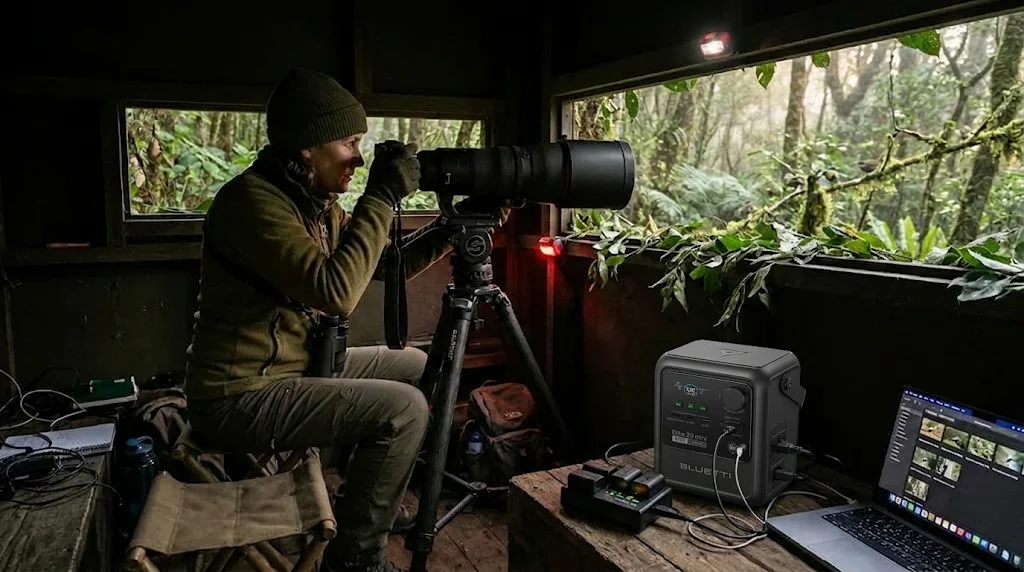
Let’s be completely honest about modern wildlife photography. We love to romanticize it as a pure, analog escape into nature. Just you, your optics, and the wild.
In reality? It is completely digital, and digital means constantly chasing battery life.
I have lost count of how many freezing mornings I have spent in marshland hides watching my camera battery icons blink red. High-speed autofocus, electronic viewfinders, drones, audio recorders, and field laptops eat through power fast. The moment your batteries die, your shoot is over. It really is that simple.
For years, keeping gear charged off-grid meant choosing between two bad options. Gas generators are loud, smelly, and scare away every bird within miles. Standard pocket power banks are light, but they run dry the second you try to charge a laptop or multiple camera batteries.
That is why I pay close attention to portable LiFePO₄ power stations. They give you silent, fume-free power right where you need it.
Recently, BLUETTI dropped two brand-new models built for completely different types of field days: the heavy-duty Apex 200 and the compact Elite 30 mini. I haven’t dragged these specific units through the mud yet, so I am not going to feed you fake field-test hype. Instead, I dug into the raw specs, the battery chemistry, and early user feedback to see what actually makes sense for wildlife photographers—and where the marketing falls short.
The Reality of Field Power: Why Traditional Setup Solutions Fail
Before comparing specific models, we need to address why power management in nature photography is uniquely difficult.
When you work out of a home studio, electricity is invisible. You plug in your charger, the green light turns on, and you keep working. In the field, every watt-hour comes with a physical tax: weight, volume, thermal sensitivity, and noise.
Historically, outdoor creators relied on two main approaches, both flawed for wildlife work:
- Gas Generators: They deliver high continuous output and run as long as you have fuel. However, they are loud, vibrate heavily, emit dangerous fumes, and require constant mechanical upkeep. In a wildlife photography context, a gas generator is useless. The moment you pull the starter cord, every mammal and bird in the vicinity clears out.
- Standard USB Power Banks: They are lightweight and easy to throw into a camera bag, but their capacity is severely limited. They can charge your phone and maybe top off a camera battery once via USB-C, but they cannot run 12V equipment, they lack pure sine-wave AC outlets, and they struggle to keep laptops or drone battery hubs powered over a multi-day trip.
This leaves a clear gap for portable solar generators built around Lithium Iron Phosphate (LiFePO₄) chemistry. They operate silently, store massive amounts of energy, charge directly from solar panels, and offer zero fumes. But not all power stations are created equal, and picking the wrong capacity or physical layout can turn your expedition into a frustrating exercise in weight management.
Putting Things in Context: How They Compare to Older BLUETTI Classics
To really appreciate what the Apex 200 and Elite 30 mini bring to the table, it helps to look at the older BLUETTI models that many wildlife photographers and van-lifers have relied on over the past few years. BLUETTI didn’t invent these categories from scratch; they clearly redesigned them based on real-world complaints about their previous generations.
From the AC200 Series to the Apex 200
If you have been following off-grid gear for a while, you probably recognize the AC200P, AC200MAX, and AC200L. Those 2,000 Wh workhorses were staples in camper setups and permanent photography hides, but they came with noticeable compromises. The older AC200L weighed over 62 lbs (28.3 kg) for 2,048 Wh of capacity, had a bulkier footprint, and maxed out at 1,200 W of solar input. Moving up to the Apex 200 solves those exact pain points: you get over 500 Wh more capacity and a massive jump to 3,000 W of solar input, all while shedding weight and shrinking the physical volume. Even compared to the newer Elite 200 V2, which lacks battery expansion, the Apex 200 wins out for serious field stations thanks to its modular scalability and direct RV-ready ports.
Read my full review on the Bluetti AC200L power station.
Read full review on the Bluetti Elite 200 V2 power station.
Moving Past the EB3A, AC2A, and Elite 30 V2
On the lightweight side, mobile shooters previously turned to units like the EB3A, AC2A, or the Elite 30 V2. While the EB3A was a budget favorite, it weighed over 10 lbs for just 268 Wh of capacity and suffered from well-documented early firmware quirks. The AC2A trimmed the weight down to 7.7 lbs, yet dropped capacity to 204 Wh and omitted USB-C recharging entirely. Even the Elite 30 V2, while offering a higher 600 W inverter, required you to carry loose cables. The Elite 30 mini trades away that extra AC wattage in favor of what trail photographers actually need: a lighter 7.3 lb frame, 288 Wh capacity, and that built-in 140W retractable USB-C cable.
Read my full review on the Bluetti Elite 30 V2 power station.
The Head-to-Head Breakdown: Heavy-Duty Basecamp vs. Mobile Day-Stalking
To understand how the BLUETTI Apex 200 and the BLUETTI Elite 30 mini fit into real-world workflows, let’s examine their technical specifications side-by-side.
| Feature | BLUETTI Apex 200 | BLUETTI Elite 30 mini |
|---|---|---|
| Primary Field Role | Multi-day basecamp, hide power, RV setup | Mobile hiking, optics charging, day trips |
| Battery Capacity | 2,560 Wh (LiFePO₄) | 288 Wh (LiFePO₄) |
| AC Output | 3,200 W Continuous (5,400 W Surge) | 300 W Continuous (600 W Surge) |
| Weight | 26.9 kg / 59.3 lbs | 3.3 kg / 7.3 lbs |
| Dimensions | 525 × 327 × 211 mm (20.67 × 12.87 in) | Compact desktop / shoulder bag footprint |
| Integrated Cable | Standard panel outlets | 140W Retractable USB-C (Two-Way) |
| Solar Input | Up to 3,000 W Dual-Input | Standard low-voltage solar compatible |
| Expansion Capability | Scalable up to 99.84 kWh (via B300K/B500K) | Standalone portable unit |
| Cycle Life | 6,000+ cycles to 70% capacity | 6,000+ cycles to 70% capacity |
Deep Dive: The BLUETTI Apex 200 (The Heavyweight Workhorse)
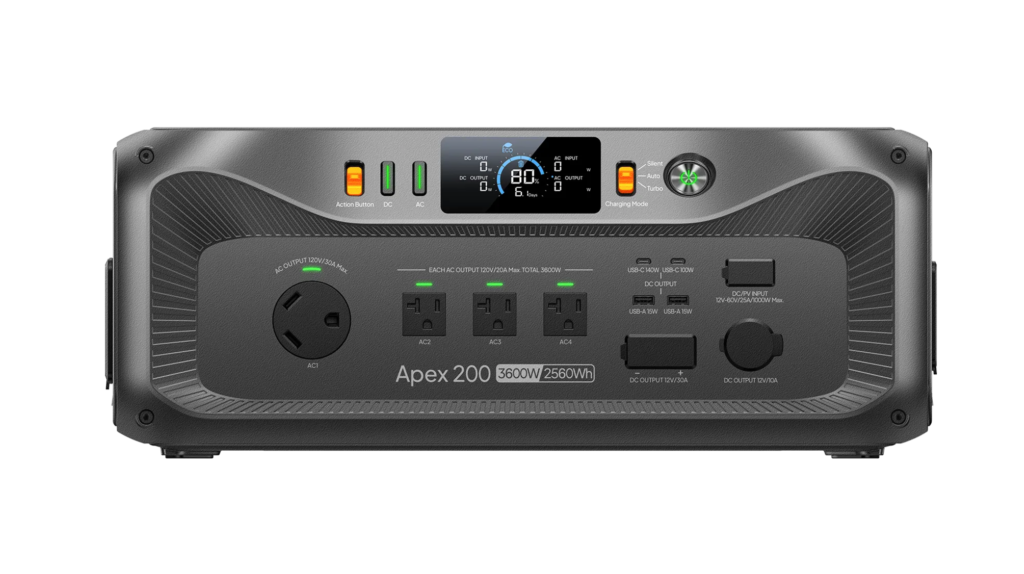
When we move away from lightweight day-packs and look at the heavy end of portable power, the BLUETTI Apex 200 occupies a very specific niche. Built around a 2,560 Wh Lithium Iron Phosphate battery and a 3,200 W continuous pure sine wave inverter (with a 3,600 W boost capability under specific conditions), this unit is engineered for serious off-grid endurance. On paper, those numbers look impressive, but in the context of wildlife photography, ornithological fieldwork, and remote hide setups, raw wattage only tells half the story. What actually matters is how this massive reservoir behaves when you are miles away from the nearest wall outlet and surrounded by sensitive wildlife.
Acoustic Invisibility in the Hide
The primary reason any nature photographer brings a battery station into a hide is acoustic invisibility. Traditional fuel generators are completely off the table around birds and mammals, as even a distant engine hum will keep skittish species away from a watering hole or perch. The Apex 200 solves this by operating near-silently. During typical photography workflows—such as running dual camera battery chargers, topping off drone hubs, and powering a laptop for midday RAW culling—the internal cooling fans barely register above a whisper.
Even when pushed under heavy loads, the acoustic output remains capped below 50 decibels. You can place this box right beside your tripod inside a cramped wooden blind or tucked into the back of a camper without worrying that a sudden fan kick-in will ruin a shot you have been waiting six hours to capture.
Compact Engineering vs. Real-World Weight
Historically, getting this much capacity meant dealing with absolute back-breakers that required two people just to load into a vehicle. BLUETTI addressed this by overhauling the internal cell architecture, achieving roughly 20% higher gravimetric energy density and 50% better volumetric efficiency compared to older 3 kWh-class stations. The result is a footprint that slides much more easily into the back of a crowded 4×4 or beneath a camper bed platform. At 26.9 kg (59.3 lbs), it is still undeniably heavy, yet it remains just within the threshold of what one healthy adult can realistically lift from a tailgate and carry a short distance into a permanent hide.
Rapid Off-Grid Solar Turnaround
Once you are stationed in the field, off-grid longevity comes down to how fast you can replenish what you burn, and this is where the Apex 200 separates itself from mid-tier units. It features a dual-input MPPT solar charging system capable of accepting up to 3,000 W of combined solar power—split between a 2,000 W high-voltage MC4 input and a 1,000 W low-voltage XT60 port. In practical field terms, if you deploy a solid array of portable panels during the harsh midday sun when bird activity naturally drops off, you can push the battery from empty to 80% in around 50 minutes. That kind of rapid turnaround means you can run power-hungry workstations all morning, edit your morning flight captures over lunch, and still enter the golden evening hours with a nearly full tank.
Heavy-Duty Ports and Smart Remote Control
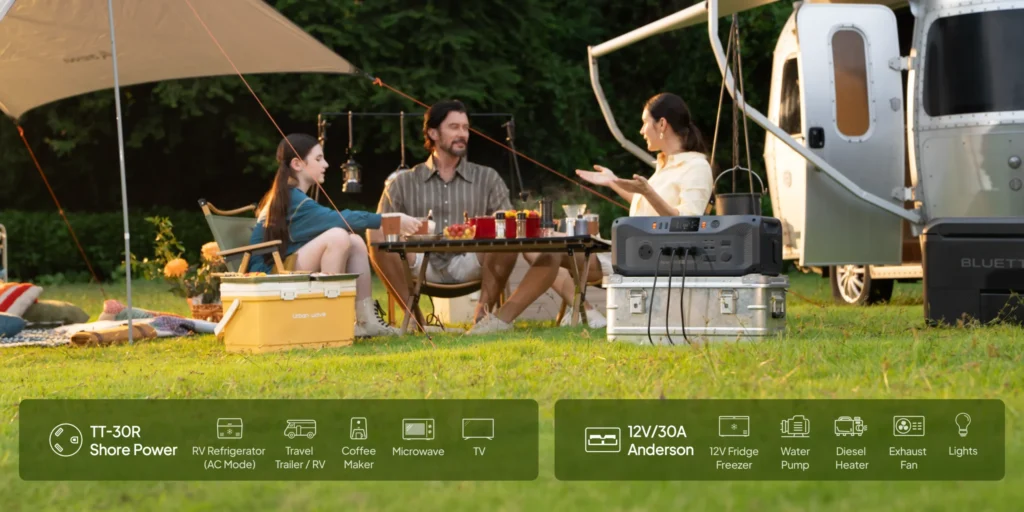
Beyond standard wall plugs, the front panel layout reflects genuine utility for mobile rigs and long-term basecamps. If you operate out of a camper van or overland truck, the built-in NEMA TT-30R (120V/30A) outlet lets you plug your vehicle’s shore power directly into the station without clunky adapters. Even better for field efficiency is the dedicated 12V/30A Anderson port. Running a 12V compressor fridge for multi-day food storage, or powering high-output 12V LED rigs and heated hide pads directly through DC, bypasses the AC inverter completely, saving a significant percentage of your battery capacity over a multi-day expedition.
Adding to that efficiency is the smart control integration via the BLUETTI app over Bluetooth or Wi-Fi. When you are sitting motionless inside a hide fifteen yards away from your truck, physically getting up to unplug a finished charger risks alerting nearby wildlife. Through the app, you can monitor exact wattage draw in real time and remotely shut off individual AC outlets once your camera batteries hit 100%, eliminating idle inverter drain without ever breaking cover. Additionally, the modular architecture lets you daisy-chain B300K or B500K expansion batteries, scaling all the way up to nearly 100 kWh with the Hub A1 if your station becomes permanent.
The Honest Critiques and Physical Trade-Offs
Still, we need to be completely honest about the physical limitations of a unit in this class. Promotional photos always make carrying a 60-pound box look effortless, but let’s stay grounded: you will not hike two miles down a muddy marsh trail with the Apex 200. Because BLUETTI omitted built-in wheels and a telescoping handle, hauling 26.9 kg across uneven terrain turns into a major chore, making this strictly a vehicle-based, boat-transported, or drive-up hide solution.
Furthermore, early technical assessments highlight a notable quirk in its solar architecture: the high-voltage MC4 input tops out at 16 Amps. If you set up rigid solar panels around a wooded hide where partial tree shade is unavoidable, wiring panels in parallel is usually best to mitigate shading losses, yet that 16A limit forces you toward series wiring instead. Finally, while the main unit delivers strong value for its base capacity, scaling up with BLUETTI’s proprietary expansion batteries remains a steep financial investment. If your typical outings only involve weekend trips where you charge two camera bodies and a smartphone, the Apex 200 is complete overkill—you will end up hauling sixty pounds of dead weight only to use fifteen percent of its capacity.
Deep Dive: The BLUETTI Elite 30 mini (The Mobile Stalker’s Companion)
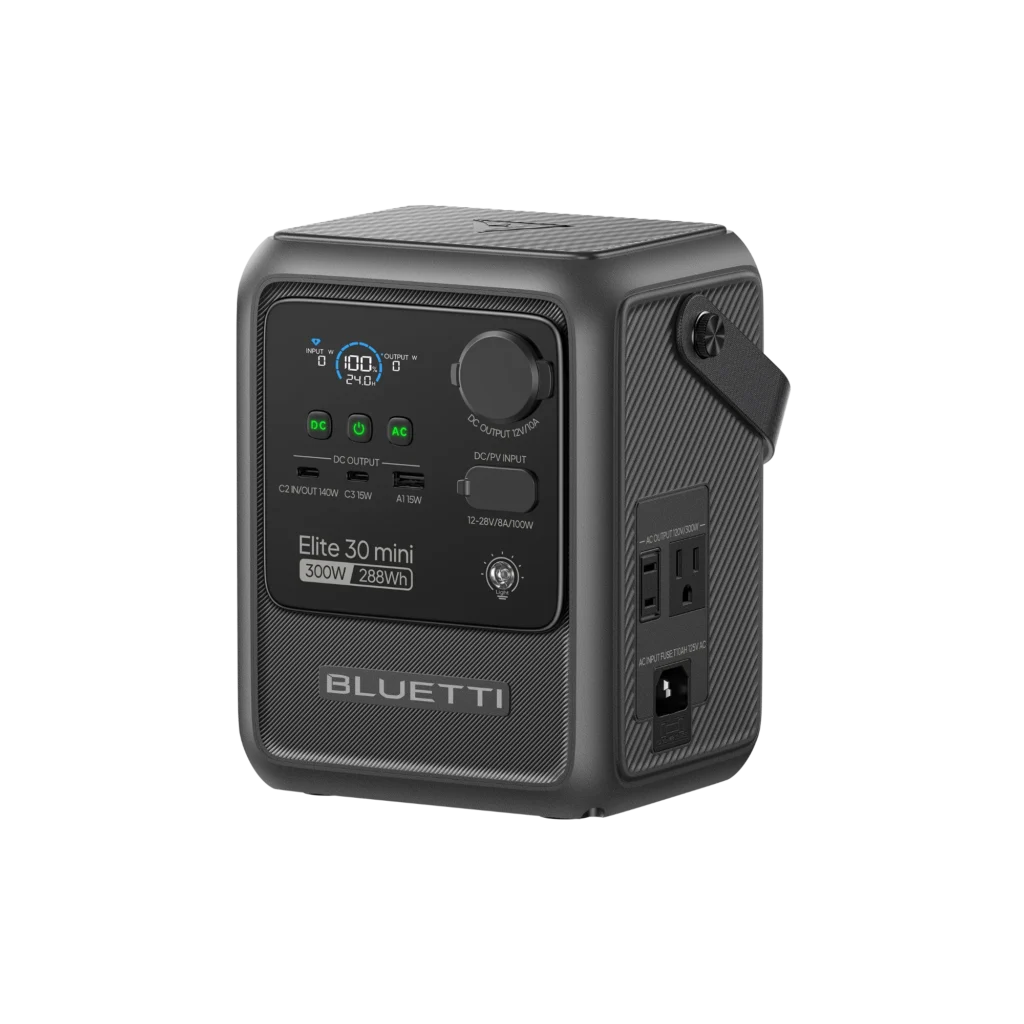
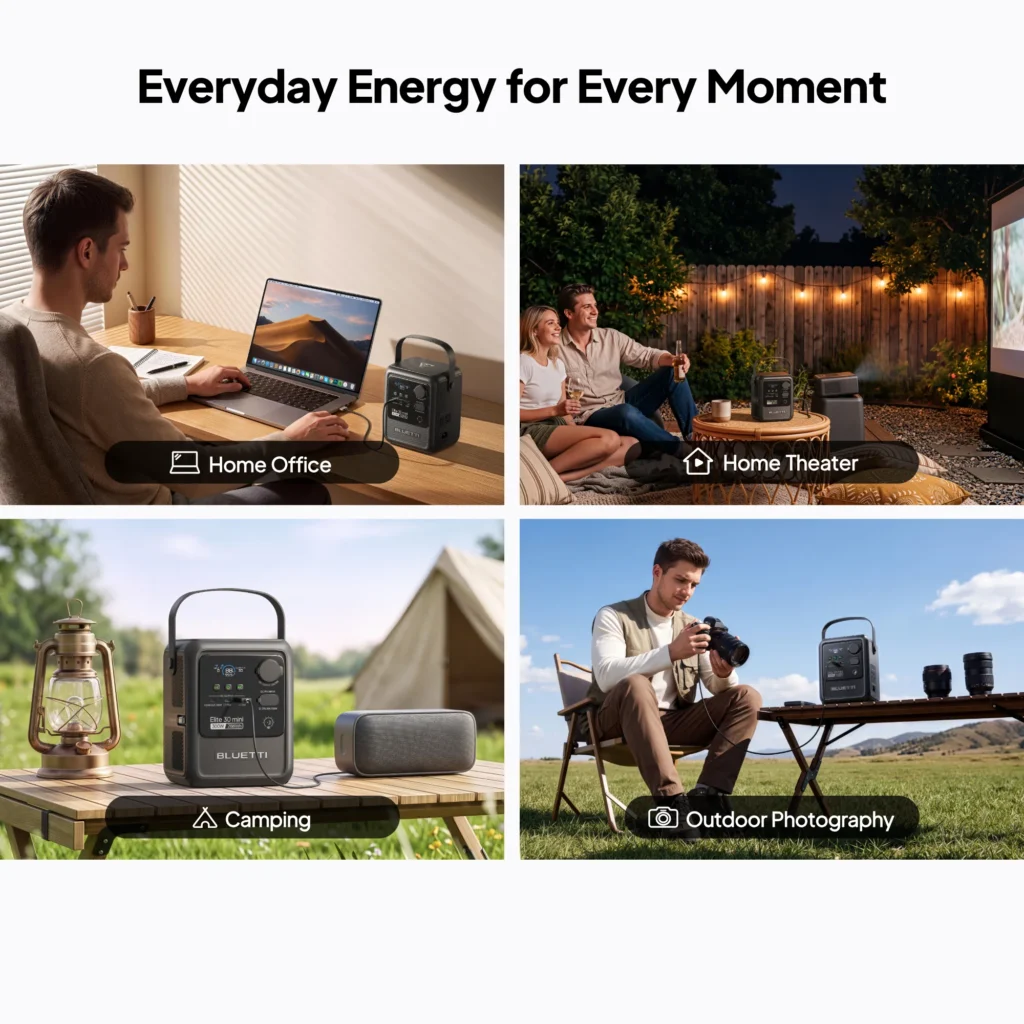
On the exact opposite end of the weight spectrum sits the newly released BLUETTI Elite 30 mini. While large power stations are built to anchor a basecamp, this unit is engineered specifically for movement. Packing 288 Wh of Lithium Iron Phosphate capacity and a 300 W continuous pure sine wave inverter (with a 600 W surge rating) into a chassis weighing just 3.3 kg (7.28 lbs), it bridges the awkward gap between flimsy pocket power banks and bulky camping generators. For wildlife photographers and birders who cover miles on foot rather than waiting beside a truck, those physical dimensions change how you pack for a day in the field.
True Trail Mobility and Silicon Carbide Efficiency
Most power stations in the 300 Wh class still feel like carrying a dense cinderblock, usually tipping the scales around 9 to 10 pounds. By integrating Silicon Carbide (SiC) power components to reduce internal heat and energy loss, BLUETTI shaved the Elite 30 mini down to 7.28 lbs with a compact footprint (161 × 130 × 207.5 mm) that easily slides into a standard camera backpack or hangs comfortably from an optional shoulder strap. When you are already hauling a heavy telephoto lens, a sturdy tripod, and binoculars across uneven marshland or coastal dunes, shaving two or three pounds off your backup power source makes a noticeable difference by the end of a six-hour hike.
Tangle-Free Charging with the Built-In 140W USB-C Cable
Anyone who has fumbled around inside a dark camera bag at 4:30 AM knows that loose charging cables are a constant headache—they tangle around tripod plates, pick up dirt, or get left behind on a desk. One of the smartest practical touches on the Elite 30 mini is its integrated, retractable 140W two-way USB-C cable. You simply pull the cord straight out of the housing, plug it directly into a mirrorless camera body, high-end field laptop, or multi-battery drone hub, and retract it cleanly when you are ready to move. Paired with a second 140W USB-C port, a standard 15W USB-C, a USB-A port, a 12V car socket, and AC outlets (totaling 7 outputs), it comfortably delivers 15 to 20 full recharges for standard camera batteries without forcing you to pack bulky wall bricks.
Rapid Turnarounds and Low-Light Utility
Field schedules rarely leave hours to sit around waiting for gear to top up. The Elite 30 mini supports five charging methods—including wall AC, solar, car outlet, and bi-directional 140W USB-C—reaching an 80% charge in roughly 46 minutes and a full charge in 103 minutes. It also handles pass-through charging and features a ≤10 ms UPS switchover, meaning you can keep your field workstation or external hard drives running seamlessly while a portable solar panel feeds the battery during a midday break. Furthermore, BLUETTI included a built-in emergency LED light on the chassis, which sounds minor until you are trying to organize filters and memory cards inside a pitch-black hide before sunrise without holding a flashlight between your teeth.
The Honest Critiques and Capacity Limits
Despite its clever packaging, you have to be realistic about what a 288 Wh box can actually accomplish. First, the 300W continuous AC output ceiling is noticeably lower than the 600W rating found on slightly heavier siblings like the Elite 30 V2. That means high-draw heating pads, electric kettles, or heavy camp appliances are strictly off the menu; this unit is built solely for cameras, optics, laptops, and communication gear. Additionally, solar input is capped at 100 W (12–28V, 8A max), so recharging off-grid takes patience if cloud cover rolls in. Finally, because the capacity is fixed and non-expandable, a multi-day trip without reliable sunlight will drain the tank completely—making it an unmatched single-day or overnight trail companion, rather than a multi-day basecamp powerhouse.
Matching Gear to Your Workflow: Which One Do You Actually Need?
Let’s skip the glossy studio shots and polished marketing copy: in the real world, every power station represents a physical trade-off. Because the Elite 30 mini and the Apex 200 are built for completely different jobs, evaluating them comes down to your actual daily movement in the field rather than pitting them against each other.
For Active Foot-Stalking: BLUETTI Elite 30 mini
If you spend the majority of your time on foot—tracking birds through coastal dunes, forest trails, or marshland paths—weight and convenience dictate everything. At just 7.3 lbs (3.3 kg), the Elite 30 mini drops easily into a daypack or slings over your shoulder alongside your optics.
Early hands-on feedback highlights the integrated 140W retractable USB-C cable as a genuine workflow upgrade. In low-light conditions, you aren’t stuck untangling loose cords or searching for charging bricks. Its 288 Wh capacity comfortably cycles mirrorless camera batteries 15 to 20 times, or keeps a laptop and drone operational during a full day out.
You simply have to respect its hard ceiling: with a 300W continuous output limit, this is strictly a small-electronics charger. High-draw heating gear or heavy camp appliances are completely out of the question.
For Static Hides & Vehicle Basecamps: BLUETTI Apex 200
The Apex 200 is an entirely different tool, built exclusively for situations where you can drive a 4×4 or camper van directly up to your photography hide or basecamp. Even though BLUETTI engineered this frame to be 20% lighter and 50% smaller by volume than older 3 kWh-class units, its 59.3 lb (26.9 kg) weight means nobody is carrying it long distances down a trail.
Once stationed, its 2,560 Wh capacity and 3,200W inverter deliver multi-day independence. Wildlife photographers will appreciate its whisper-quiet operation (under 50 dB) and the direct 12V/30A Anderson port, which runs 12V field fridges natively without AC inverter conversion losses. Furthermore, its 3,000W dual solar input can restore 80% of the battery in under an hour during midday lulls.
However, technical reviews point out a couple of practical caveats: its high-voltage solar MPPT input caps out at 16 Amps, meaning you will need to wire rigid solar panels in series rather than parallel if dealing with partial tree shade around a hide. Also, while the base unit launch price is competitive, BLUETTI’s proprietary expansion batteries (B300K/B500K) remain a steep investment if you plan to scale up later.
The Hybrid Two-Tier Setup
If your fieldwork splits between a vehicle camp and long foot excursions, these two units serve naturally complementary roles. You can leave the Apex 200 inside your vehicle or main hide as a solar-fed central energy bank, while carrying the lightweight Elite 30 mini in your backpack during daytime hikes. When you return to base at night, simply plug the Elite 30 mini into the Apex 200 to top it back up for the next morning’s outing.
Battery Chemistry: Why LiFePO₄ Matters for Long-Term Field Use
When you are investing serious money into off-grid gear, looking past the wattage numbers on the box and examining the actual cell chemistry inside is critical. Both the Apex 200 and the Elite 30 mini are built around Lithium Iron Phosphate (LiFePO₄) battery cells rather than the traditional Nickel Manganese Cobalt (NMC) chemistries found in older power stations and standard consumer electronics. For wildlife photographers and field researchers who put their gear through relentless seasonal cycles, that chemical difference changes the long-term math entirely.
A Decade of Service Instead of Two Seasons
Standard lithium-ion batteries typically begin losing noticeable capacity after 500 to 1,000 full charge cycles, meaning heavy outdoor users often find themselves shopping for replacements after just two or three busy field seasons. By contrast, both of these BLUETTI units are rated for over 6,000 charge cycles before dropping to 70% of their original capacity. Even if you were to take either unit into the field and run a full drain-and-recharge cycle 200 days every single year, you are looking at more than a decade of reliable service—meaning the battery cells will likely outlast several generations of your camera bodies.
Thermal Stability and the Freezing Weather Catch
Beyond longevity, LiFePO₄ chemistry offers superior thermal stability, carrying virtually zero risk of thermal runaway or combustion if punctured or left sitting inside a scorching vehicle parked beside a marsh all afternoon. However, let’s be completely honest about its biggest real-world limitation in the field: freezing temperatures. While both stations can safely discharge and power your gear down to -20°C (-4°F), LiFePO₄ cells cannot be safely charged below 0°C (32°F) without risking permanent lithium plating inside the battery. If you are working winter hides or sub-zero migratory routes, the internal Battery Management System will block solar or AC charging until the unit warms back up above freezing—something you have to plan around by keeping the station insulated inside your tent or vehicle overnight.
Final Thoughts: No Hype, Just the Right Tool for the Job
At the end of the day, field power should be completely invisible. It shouldn’t weigh down your workflow, require constant cable troubleshooting in the dark, or create mechanical noise that ruins a dawn shoot. Looking at these two new releases honestly, BLUETTI clearly understood that a single “do-it-all” box is a myth, splitting their engineering into two distinct tools for two completely different field realities.
My honest take is straightforward: if I am heading out on foot for a long day of tracking waders or hiking forest trails, the Elite 30 mini is the exact kind of no-nonsense pack companion I want. The built-in retractable 140W USB-C cable solves a genuine daily annoyance, and its 3.3 kg weight actually respects your back. Just don’t buy it expecting to run heavy camp gear or survive three overcast days without a recharge—treat it as a fast, rugged charging hub for your cameras, laptop, and drone, and it excels.
On the flip side, if you are working out of a vehicle, a camper rig, or a static photography hide where you need silent, multi-day independence, the Apex 200 is a remarkably capable powerhouse. Its 2,560 Wh capacity, whisper-quiet operation, and rapid solar recharge turnaround make it ideal for serious expeditions. Still, my main critique remains the physical reality of moving 27 kilograms without built-in wheels, alongside the high cost of proprietary expansion batteries if you decide to scale up later. Don’t buy into glossy marketing promises of effortless portability with a 60-pound unit. Be brutally honest about how far you actually carry your gear from your vehicle, pick the unit that matches your physical workflow, and get back to focusing on what really matters out in the wild.
Frequently Asked Questions (FAQ)
Is the BLUETTI Apex 200 quiet enough to keep inside a wildlife photography hide?
Yes. Under light-to-moderate loads—such as charging mirrorless camera batteries, running drone hubs, or powering a field laptop—the internal cooling fans barely register above a whisper. Even under heavy electrical draw, noise levels stay capped below 50 dB, meaning it will not startle skittish birds or mammals outside your blind.
How many camera batteries can the BLUETTI Elite 30 mini actually charge?
With 288 Wh of usable LiFePO₄ capacity, the Elite 30 mini will comfortably recharge a standard mirrorless camera battery (typically rated between 14 Wh and 18 Wh) roughly 15 to 20 times on a single charge, accounting for normal conversion efficiency. If you are also topping off a laptop or drone batteries, expect a full day of mixed electronic use rather than multi-day endurance.
Can I use either power station in freezing winter birding conditions?
You can safely use both units to power and discharge your gear in freezing temperatures down to -20°C (-4°F). However, because both use Lithium Iron Phosphate (LiFePO₄) chemistry, their internal Battery Management Systems will block solar or AC charging when the battery cells drop below 0°C (32°F) to prevent permanent damage. In winter hides, keep the unit inside an insulated bag or warm vehicle before plugging it into solar panels or wall outlets.
Can I expand the battery capacity of the Elite 30 mini later on?
No. The Elite 30 mini is a fixed, standalone 288 Wh unit designed strictly for lightweight portability. If you think you will need multi-day expansion capabilities down the road, the Apex 200 is the better investment, as it connects natively to BLUETTI B300K and B500K expansion batteries.
Do I need to pack separate charging bricks for my laptop and camera with the Elite 30 mini?
For most modern gear, no. The Elite 30 mini features a built-in, retractable 140W two-way USB-C cable alongside an additional 140W USB-C port. You can plug directly into modern mirrorless camera bodies, MacBooks, high-end PC workstations, and USB-C drone hubs without carrying bulky AC wall adapters.
Why does the Apex 200’s 16A solar input limit matter for woodland setups?
The Apex 200 supports up to 2,000 W of high-voltage solar input (60V–280V), but its current limit is capped at 16 Amps. When setting up rigid solar panels around trees where partial shade is common, wiring panels in parallel is usually preferred to minimize shading drops. Because of the 16A ceiling, connecting high-amperage panels in parallel can clip your charging speed, making series wiring the better configuration for this unit.
Disclosure: Some of the links in this article are affiliate links. If you decide to pick up one of these power stations through my links, I may earn a small commission at no extra cost to you. This helps keep gotobirding.com running and allows me to keep producing honest, independent gear breakdowns—and as always, every critique and trade-off mentioned here is my own unfiltered take.

Lorand Vigh is a nature conservation professional and lifelong birder based in Serbia (Vojvodina). With over 30 years of field experience in birdwatching, habitat protection, and conservation management, he has worked on bird monitoring projects, habitat restoration initiatives, and cross-border conservation cooperation. GoToBirding is a personal project built on real field experience, sharing practical, science-based advice for birders and wildlife photographers.