

Every year, I see the same discussion surface among bird photographers: should I upgrade now, or wait just a little longer? I’ve written before that waiting can easily become a habit rather than a strategy, especially in a field where today’s cameras are already incredibly capable. Still, keeping an eye on what’s coming makes sense — particularly if your current setup is starting to limit what you can realistically photograph.
Based on industry trends, long‑term product cycles, and informed speculation from the photography community, 2026 is shaping up to be a year of evolution rather than revolution. We are unlikely to see completely new categories of cameras, but several highly anticipated updates could significantly improve the bird photography experience.
As I’ve mentioned in earlier posts on GoToBirding, camera development has slowed in visible leaps but accelerated in subtle, practical improvements. Autofocus reliability, subject recognition, rolling shutter control, and real-world handling now matter far more than headline megapixels. With that in mind, 2026 looks less like a year of dramatic disruption and more like a year of important refinements, especially for bird and wildlife photographers.
This article looks at the most anticipated camera releases for 2026, with a clear focus on what actually matters for birdwatchers and wildlife photographers. I’ll walk through the most anticipated camera releases from a birder’s perspective, building on what I’ve already written about Canon, Nikon, Fujifilm, and Sony — and being honest about where expectations should remain cautious.
What Bird Photographers Should Realistically Expect in 2026
Before focusing on individual models, it’s worth grounding expectations. Camera brands are no longer reinventing their systems every generation. Instead, progress shows up in areas that only become obvious after long hours in the field:
- More dependable bird-eye detection in complex backgrounds
- Fewer focus dropouts when branches or reeds cross the frame
- Faster sensor readout to reduce rolling shutter on birds in flight
- Better consistency at high ISO during early mornings and late evenings
- Refinements to ergonomics that reduce fatigue during long sessions
If 2026 delivers improvements in these areas, it will be a meaningful year for bird photographers — even if spec sheets don’t look revolutionary.them.
Canon EOS R7 Mark II – One of the Most Important APS‑C Cameras to Watch
As I wrote earlier about Canon’s APS-C lineup, the original EOS R7 quietly became one of the most practical bird photography cameras in Canon’s mirrorless range. It never felt like a flagship, but in the field it proved itself where it mattered: reach, speed, and autofocus reliability.
The R7 Mark II, expected by many in 2026, should be viewed less as a reinvention and more as a refinement of an already strong concept. Canon has learned a great deal from user feedback on the R7, particularly from wildlife photographers who rely heavily on electronic shutter shooting.

Key areas where a Mark II model realistically needs improvement include:
- Faster sensor readout to reduce rolling shutter on fast wingbeats
- More confident bird-eye detection when subjects are partially obscured
- Improved buffer performance for long action sequences
- Slight refinements to body balance when using long RF telephoto lenses
As I noted in my previous post about Canon’s RF wildlife ecosystem, APS-C still makes enormous sense for bird photography. A refined R7 Mark II would likely remain one of the best reach-to-price options available, especially for birders who spend a lot of time photographing small or distant species.
That said, Canon will need to be careful not to price this camera too close to full-frame alternatives, as its value lies in efficiency, not luxury.rice range.
Nikon Z9 II – Flagship Power for Serious Wildlife Shooters
Nikon’s Z9 is already one of the most capable wildlife cameras available, and a Z9 II is widely expected at some point around 2026.
For bird photographers, the original Z9 brought:
- Outstanding subject detection
- Extremely fast burst shooting
- Excellent image quality
- No mechanical shutter, reducing wear
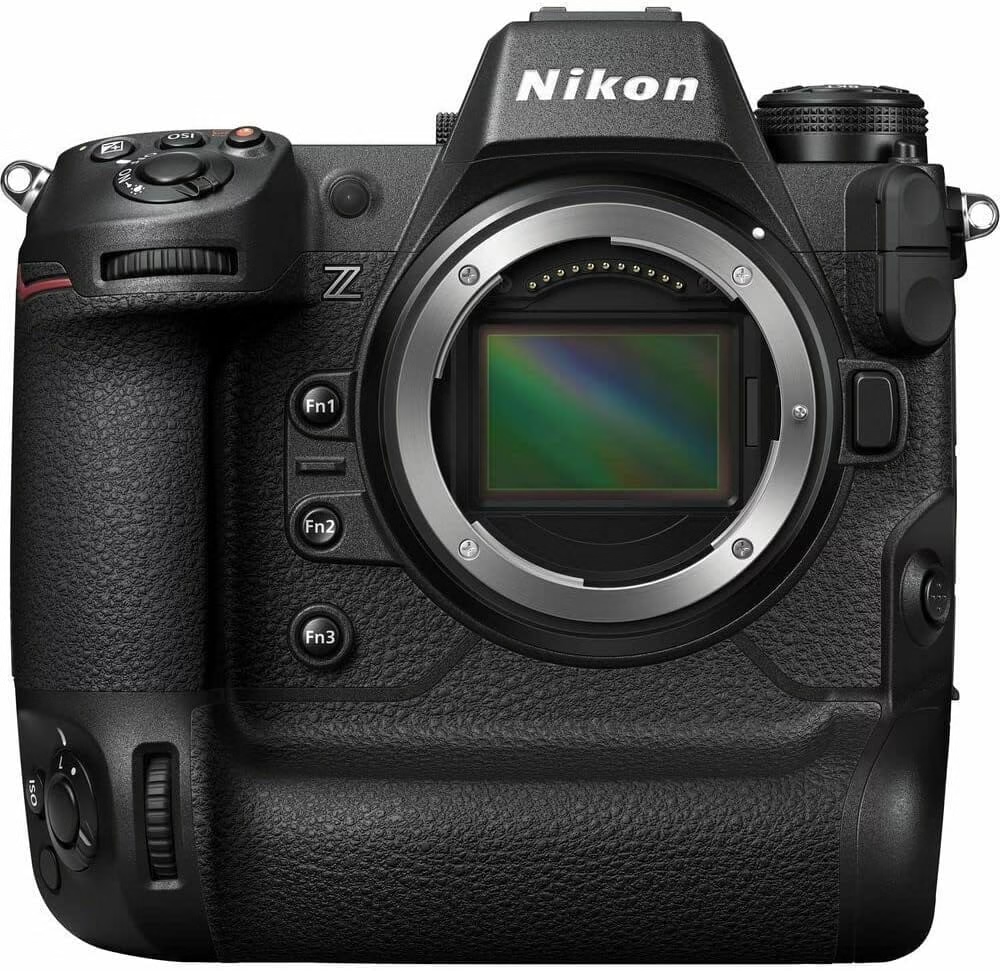
A second‑generation model would likely focus on refinement rather than reinvention. Possible improvements include:
- Faster and smarter bird recognition
- Better low‑light autofocus performance
- Improved processing efficiency
- Minor weight or handling refinements
This is not a camera most casual birders will buy, but for professionals and dedicated wildlife photographers, a Z9 II could set a new benchmark for speed and reliability in demanding conditions.
Nikon Z7 III – High Resolution with Wildlife Potential
The Z7 line has always occupied an interesting and sometimes slightly uncomfortable position in Nikon’s lineup. As I’ve hinted before in several posts, high resolution is both a strength and a potential liability for bird photography — and Nikon’s recent releases make that contrast clearer than ever.
Having written about the Nikon Z9 and Nikon Z8, it’s obvious that Nikon’s real wildlife priorities in recent years have focused on speed, reliability, and subject detection rather than sheer megapixel counts. Both cameras set a high standard for birds in flight, difficult backgrounds, and unpredictable behavior. At the same time, my thoughts on the Nikon Z6 III highlighted how Nikon is pushing performance and autofocus sophistication even in lower-resolution bodies, while the Nikon Zf showed that Nikon is also willing to prioritize shooting experience and character — even if that means accepting certain compromises.
Seen in this context, a Nikon Z7 III would need to justify its place very carefully. High resolution only makes sense for bird photographers who genuinely benefit from it. A Z7 III could be particularly appealing for those who:
- Regularly photograph small or very distant birds
- Rely heavily on cropping while still needing fine feather detail
- Prioritize image quality and tonal detail over maximum burst rates
However, Nikon will need to strike a careful balance. If autofocus speed, tracking confidence, and buffer depth don’t keep pace with the progress seen in the Z8 and Z9, the Z7 III risks remaining a specialist tool rather than a true all-round wildlife camera.
For perched birds, slower-moving subjects, and controlled situations, it could be an excellent choice. For demanding birds-in-flight photography, expectations should remain realistic — and Nikon’s own lineup already offers better-suited alternatives.
Fujifilm X‑T6 – APS‑C Speed and Portability
Fujifilm’s X‑T series has long been appreciated for its handling, color science, and compact APS‑C bodies.
In my previous article about the Fujifilm X-T5, I highlighted why Fujifilm’s APS-C system continues to attract bird photographers who value portability. A potential X-T6 would build directly on that foundation.

Fujifilm has made steady progress with subject detection, but continuous autofocus reliability remains the area where bird photographers are most critical. An X-T6 could become a genuinely strong wildlife tool if Fujifilm focuses on:
- More consistent tracking for birds in flight
- Improved buffer depth for action sequences
- Better battery endurance in cold conditions
- Further refinement of autofocus algorithms rather than new modes
For travel birding, long hikes, and situations where weight matters, an improved X-T6 could be one of the most enjoyable cameras to use — provided Fujifilm continues listening to real-world feedback.
Sony a7R VI – Incredible Detail, With Trade-Offs
With the recent release of the Sony a7 V, Sony has once again underlined where its real strength lies: rapid iteration in autofocus intelligence, AI-driven subject recognition, and sensor-level innovation. That context matters when looking ahead to a future Sony a7R VI, because it gives us a fairly clear idea of how Sony is likely to evolve its high-resolution line.

As I’ve mentioned before when discussing the a7R VI in earlier Sony-related posts, Sony’s advantage is not just resolution for its own sake, but the way high-resolution sensors are paired with increasingly sophisticated autofocus systems. An a7R VI will almost certainly push resolution further while also refining AI-based bird and animal recognition, building directly on lessons learned from cameras like the a7 V.
For bird photographers, this combination creates both opportunity and compromise. Extremely high resolution is a powerful advantage when photographing small or distant birds, especially for heavy cropping, but it comes with clear demands:
- Precise, disciplined shooting technique
- High-quality, fast telephoto lenses
- Consistent and predictable autofocus behavior
If Sony manages to improve sensor readout speed and buffer handling, an a7R VI could be an exceptional tool for distant subjects, perched birds, and more controlled action. However, it’s important to remain realistic. Even with improvements, it is unlikely to replace Sony’s faster, lower-resolution bodies for demanding birds-in-flight work, where responsiveness and frame rate still matter more than ultimate detail.
Retro‑Style Cameras: Interesting, But Not for Birding
Some manufacturers are exploring retro‑inspired designs. While these cameras can be fun and creatively inspiring, they are generally not optimized for bird photography.
Smaller grips, limited burst rates, and reduced weather sealing often make them better suited for street or travel photography than long telephoto wildlife work.
For birders, these releases are interesting from a design perspective, but unlikely to be practical tools in the field.
Should Bird Photographers Wait for 2026 Cameras?
This is the most common question — and the answer depends on your current gear and needs.
You might consider waiting if:
- Your current camera struggles with bird‑eye autofocus
- You frequently miss shots due to slow burst rates
- You plan a major upgrade anyway and can wait comfortably
You should probably buy now if:
- Your current setup already meets your needs
- You are missing real‑world opportunities today
- You find a good deal on proven wildlife gear
Modern cameras are already extremely capable. Waiting for rumored models only makes sense if you clearly understand what problem you are trying to solve.
Final Thoughts: A Practical Year for Bird Photographers
From my perspective, 2026 appears to be a year of refinement and optimization rather than radical innovation. Cameras will get smarter, faster, and more reliable — but the fundamentals remain the same. It seems to me that the camera makers focus on making their tools more dependable rather than more impressive on paper. For bird photographers, that’s exactly the kind of progress that counts. It means investing in current gear is still a safe choice, while upcoming releases may offer meaningful but incremental improvements rather than forcing dramatic changes in shooting style or workflow.
As I’ve written many times on GoToBirding, the best camera is not the newest one, but the one that lets you stay focused on birds rather than menus, settings, or technical distractions. If upcoming releases improve that relationship — even quietly — they will be worth paying attention to.
In the meantime, today’s cameras are more than capable of producing outstanding bird photographs. Don’t postpone real experiences in the field for the promise of hypothetical gear. Birds won’t wait for product launches.
If you want help choosing between current models or deciding whether to wait for an upcoming release, explore in‑depth guides here on GoToBirding.com, where I focus on real‑world bird photography — not just spec sheets.

Lorand Vigh is a nature conservation professional and lifelong birder based in Serbia (Vojvodina). With over 30 years of field experience in birdwatching, habitat protection, and conservation management, he has worked on bird monitoring projects, habitat restoration initiatives, and cross-border conservation cooperation. GoToBirding is a personal project built on real field experience, sharing practical, science-based advice for birders and wildlife photographers.