

A rumored dual-resolution sensor, extraordinary burst speeds, improved autofocus, and a possible new direction for Canon’s professional camera lineup. Could the EOS R3 Mark II become one of the most interesting cameras for bird and wildlife photographers?
Last updated: November 23, 2026
The Canon EOS R3 has always occupied an interesting position in Canon’s mirrorless camera lineup. It was never simply a higher-resolution alternative to the EOS R5. Instead, Canon designed it around speed, responsiveness, autofocus performance, and reliability when photographing subjects that rarely stay still for long.
For sports photographers, wildlife professionals, and bird photographers, these qualities can be more important than having the highest possible megapixel count.
Now, attention is turning toward a possible successor: the Canon EOS R3 Mark II.
Rumors surrounding this camera have become particularly interesting in 2026. Some reports describe an entirely new sensor concept, with two selectable native resolutions, potentially combining the advantages of high-resolution photography with the speed and sensitivity required for demanding action photography.
The reported specifications sound impressive. A 54-megapixel mode, a 24-megapixel high-speed mode, burst shooting at up to 90 frames per second, and a new generation of autofocus technology would represent a significant development.
However, there is an important distinction between an exciting rumor and a confirmed product. As of November 23, 2026, Canon has not officially announced the EOS R3 Mark II. There is no confirmed specification sheet, release date, product image, or official price.
In this article, I will look at the available information, explain what the rumored technologies could mean, and consider whether an R3 Mark II would make sense for bird and wildlife photography.
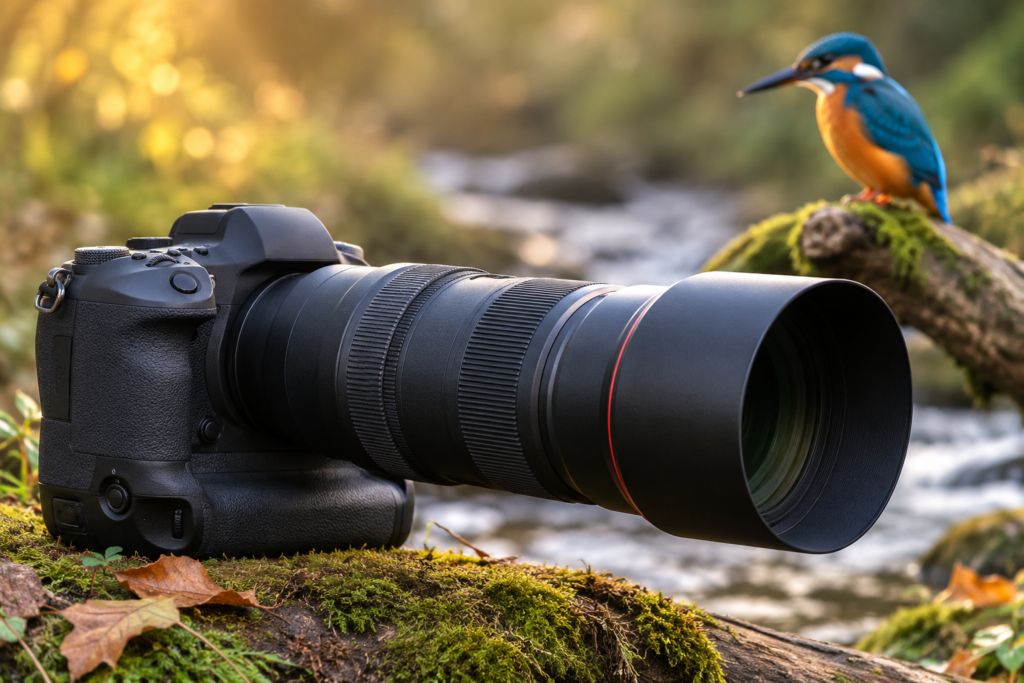
1. Why Is the Canon EOS R3 Mark II Attracting Attention?
The EOS R3 was introduced as a professional mirrorless camera built for speed and demanding assignments. Its 24.1-megapixel stacked full-frame sensor, excellent subject tracking, integrated vertical grip, and high-speed electronic shutter made it a particularly interesting option for sports and wildlife photographers.
It also introduced Canon’s Eye Control AF technology to the EOS R system, allowing photographers to select a focusing area by looking through the electronic viewfinder.
The R3 was never intended to compete directly with the EOS R5 in resolution. Its purpose was different: to give photographers a camera that could react quickly and consistently.
That distinction is important when considering its successor. The EOS R1 now occupies the top position in Canon’s professional mirrorless range, while the R5 Mark II offers a combination of high resolution and impressive speed. A future R3 Mark II could potentially occupy an interesting space between these approaches.
There is also a recent development worth mentioning. On November 3, 2026, reports noted that Canon Japan had listed the EOS R3 as “Sales Ended.” This may indicate that the current model is approaching the end of its commercial life in that market. However, a product being listed as unavailable or sales-ended in one market does not automatically mean that its replacement is ready for announcement.
It is a reason to watch the situation, not proof of an imminent launch.
2. The Most Interesting Rumor: A Dual-Resolution Sensor
Perhaps the most unusual claim about the rumored EOS R3 Mark II concerns its sensor. According to an unconfirmed report published in February 2026, the camera could feature a back-illuminated stacked CMOS sensor with two selectable native resolutions:
- 54 megapixels for maximum image detail.
- 24 megapixels for faster shooting and potentially improved sensitivity.
If this information proves accurate, it could be one of the most interesting sensor developments in Canon’s full-frame mirrorless system. Most cameras offer different image sizes, but reducing the output resolution is not necessarily the same as changing the sensor’s native operating mode.
The rumored system appears to describe a more fundamental approach, potentially using a specially designed pixel arrangement and pixel-binning technology.
Why would two native resolutions be useful?
Consider two different wildlife photography situations. You are photographing a resting owl in a tree. The bird is relatively stationary, the light is good, and you want as much detail as possible. A 54-megapixel image could provide additional flexibility when cropping, printing, or examining fine feather detail.
Now imagine photographing a swallow flying across an open field. The bird moves quickly, changes direction unexpectedly, and occupies only a small part of the frame. You need a responsive autofocus system and a high shooting speed. A 24-megapixel mode could potentially reduce the amount of data the camera needs to process and write.
In theory, this could allow the photographer to choose the most appropriate sensor mode for the situation. It would be particularly interesting if the lower-resolution mode genuinely improved high-ISO image quality rather than simply producing smaller files.
What is pixel binning?
Pixel binning is a technique in which information from neighboring sensor pixels is combined to produce an image with fewer output pixels. Depending on the sensor design, this can improve signal quality and reduce noise, particularly in situations where light is limited.
However, the result depends heavily on the actual sensor architecture, readout electronics, processing, and how the data is combined. It is important not to assume that every 24-megapixel image produced from a higher-resolution sensor will automatically have better image quality than an image captured by a dedicated 24-megapixel sensor.
For wildlife photographers, this could be especially valuable during early morning and late evening sessions, when birds are active but the available light is limited.
3. Could 90 Frames Per Second Change Action Photography?
Another eye-catching part of the February rumor is the claimed burst shooting performance. The reported figures are:
| Shooting mode | Rumored speed |
|---|---|
| 24 MP mode | Up to 90 fps |
| 54 MP mode | Up to 40 fps |
These numbers are not confirmed Canon specifications. Nevertheless, they provide an interesting starting point for discussing what a camera of this type could offer.
For comparison, the existing EOS R3 offers up to 30 frames per second with its electronic shutter, while the EOS R1 offers up to 40 frames per second. The EOS R5 Mark II also reaches up to 30 frames per second. A potential 90 fps mode would therefore represent a substantial increase over the current professional EOS R cameras.
What does this mean for bird photography?
High-speed continuous shooting can be useful in several situations:
- Birds taking off from branches.
- Kingfishers diving into water.
- Swallows changing direction in flight.
- Birds fighting or displaying.
- Raptors catching prey.
- Small birds jumping between branches.
A fast sequence can increase the chance of capturing a particularly interesting moment. For example, photographing a kingfisher diving into water is difficult because the entire movement happens extremely quickly. Even experienced photographers can struggle to capture the exact moment they want.
A higher frame rate could provide more opportunities to select the best frame. However, more photographs do not automatically mean more successful photographs. Autofocus accuracy, subject recognition, shutter response, exposure, and the photographer’s timing remain essential.
A 90 fps camera would also create a substantial amount of data. Storage capacity, buffer depth, card performance, file management, and computer processing would all become important considerations. I would be particularly interested in knowing how long the camera could maintain its maximum shooting speed while recording RAW files.
A headline frame-rate figure is only part of the story.
4. A New Autofocus System: What Could Quad Pixel CMOS AF Mean?
Autofocus could be just as important as the rumored sensor. The original EOS R3 already has a sophisticated autofocus system, including subject recognition and Eye Control AF. The EOS R1 and R5 Mark II have introduced further developments in Canon’s subject-tracking technology.
The R3 Mark II rumor goes further, mentioning a possible Quad Pixel CMOS AF system. According to the original report, this technology would use four photodiodes per pixel to enable phase-detection autofocus in multiple directions.
The suggested advantage is more consistent focusing information across different subject orientations. Traditional phase-detection systems can sometimes struggle with certain patterns, especially when the subject has little contrast in the direction used by the autofocus system.
A more multidirectional autofocus arrangement could potentially improve focusing reliability in challenging situations. However, Quad Pixel CMOS AF remains an unconfirmed rumor. We do not yet know whether Canon is developing this technology for a future R3 model.
Why this matters for birds
Birds are difficult subjects for autofocus systems. A small bird can move behind branches, disappear against a complicated background, or change direction without warning. A camera may initially recognize the bird correctly but then lose it when another object enters the frame.
A more advanced autofocus system could potentially improve bird and animal recognition, eye detection for smaller subjects, tracking through temporary obstructions, focus acquisition in difficult lighting, and tracking during rapid changes in movement.
I would also like to see improvements in the practical behavior of the autofocus system, rather than simply more recognition categories. For bird photography, the ability to maintain focus on a small, partially obscured bird is often more useful than a system that recognizes many different animals but struggles to maintain tracking.
5. Low-Light Performance Could Be One of Its Biggest Advantages
Bird photographers frequently work in difficult lighting conditions. Early morning is often one of the best times to photograph wildlife, but it is also when light levels are relatively low. In woodland, dense vegetation, or shaded wetland habitats, the available light can be limited even after sunrise.
This creates a familiar challenge: photographers need a fast shutter speed to freeze movement, but increasing ISO introduces more visible noise. The rumored dual-resolution sensor could potentially address part of this problem.
The original February report also mentioned a redesigned Bayer color-filter arrangement and an approximately 80% improvement in sensitivity in the lower-resolution mode compared with the original EOS R3. It also referred to something described as Triple Native ISO. These are particularly ambitious claims, and there is currently no independent test data to support them.
Nevertheless, the underlying idea is interesting. If a future camera could combine a high-resolution mode with a genuinely improved low-light mode, it would offer greater flexibility than a conventional high-resolution sensor.
Why high ISO performance matters
Imagine photographing a small bird sitting in a shaded tree. You might need a shutter speed of 1/1600 second or faster to keep the subject sharp, particularly if it is moving. With limited light, the camera must compensate through a wider aperture or higher ISO.
A lens with a large maximum aperture can help, but it cannot solve every situation. Better sensor sensitivity and improved noise processing could preserve more feather detail and natural colors in difficult lighting.
The important question is not simply how high the camera’s ISO setting can go. What matters is how much usable detail remains in the final image, especially after cropping.
6. What About Video? Could the R3 Mark II Become a Serious Hybrid Camera?
The original rumor also includes ambitious video specifications: up to 9K RAW recording at 60 fps and up to 6K RAW recording at 120 fps. These figures would place the rumored camera in a very interesting position for professional video production. However, there is currently no official confirmation of either recording mode.
For wildlife photographers, video capabilities are becoming increasingly important. A camera that can capture high-quality still images and professional video can be useful for documenting animal behavior, recording birds in their natural habitats, and producing educational content.
However, I would not consider 9K recording essential for most bird photographers. Reliable autofocus, manageable file sizes, recording limits, heat management, stabilization, and good low-light performance would matter more in everyday field use.
A camera can have impressive video specifications on paper but still be less practical if recording creates excessive heat or requires an expensive storage and editing setup. For wildlife filmmaking, dependable performance is more valuable than an impressive specification that is difficult to use in the field.
7. Design and Ergonomics: Will Canon Keep the Integrated Grip?
One of the defining features of the original EOS R3 is its integrated vertical grip. This makes it different from cameras such as the EOS R5 Mark II, which have a more conventional body design.
An integrated grip offers several advantages for professional photographers. It provides dedicated vertical controls, a larger physical body, and space for a substantial battery. For photographers who spend long hours covering sporting events or photographing wildlife, this design can be very comfortable.
I would expect an R3 successor, if Canon develops one, to retain this professional design philosophy. However, there are disadvantages. The integrated grip increases the camera’s size and weight, making it less convenient for photographers who prefer lightweight equipment.
For someone walking long distances through wetlands, forests, or mountain habitats, this is not an insignificant consideration. The camera’s ergonomics should therefore be evaluated in relation to the type of photography being done.
At this stage, there are no verified photographs or confirmed design details of the EOS R3 Mark II.
8. Canon EOS R3 Mark II vs. EOS R5 Mark II vs. EOS R1
To understand where a future R3 Mark II might fit, it is useful to look at Canon’s existing professional cameras. The EOS R5 Mark II, EOS R1, and original EOS R3 each approach photography from a slightly different direction.
| Feature | EOS R3 | EOS R5 Mark II | EOS R1 |
|---|---|---|---|
| Sensor resolution | 24.1 MP | 45 MP | 24.2 MP |
| Sensor type | Stacked CMOS | Stacked CMOS | Stacked CMOS |
| Maximum electronic burst | 30 fps | 30 fps | 40 fps |
| Integrated grip | Yes | No | Yes |
| Eye Control AF | Yes | Yes | Yes |
| Main priority | Speed and action | Resolution and speed | Professional action |
| 8K video | No | Yes | No |
The EOS R3 and EOS R1 are particularly focused on action photography, while the R5 Mark II offers more resolution without sacrificing too much speed. The rumored EOS R3 Mark II could potentially combine some of the advantages of both approaches.
Its reported 54-megapixel mode would offer more resolution than the R5 Mark II, while the rumored 24-megapixel mode could prioritize speed and sensitivity. But we should not assume that it would automatically outperform the existing cameras.
A camera’s real performance depends on much more than its sensor resolution and maximum frame rate. Autofocus reliability, image quality, dynamic range, buffer performance, battery life, and handling all contribute to the final result. The R3 Mark II column must remain provisional until Canon publishes official specifications.
9. Would the EOS R3 Mark II Be Better for Bird Photography Than the EOS R5 Mark II?
This is probably one of the most interesting questions for Canon wildlife photographers. The EOS R5 Mark II already offers a very attractive combination of resolution, autofocus, and speed. Its 45-megapixel sensor provides plenty of detail, particularly when photographing smaller birds that occupy only part of the frame.
Read the full Canon R5 Mark II review.
The camera can also shoot at up to 30 frames per second with its electronic shutter. For many wildlife photographers, this is already more than sufficient.
The rumored R3 Mark II would potentially offer two advantages: a higher-resolution 54-megapixel mode and a much faster 24-megapixel mode. If both modes deliver excellent image quality, the camera could become an exceptionally versatile tool.
The advantage of 54 megapixels
More resolution can be useful when photographing small birds from a distance. Even with a long telephoto lens, the subject may occupy only a relatively small part of the frame. A higher-resolution sensor provides more room for cropping while preserving detail.
For example, when photographing a distant warbler, a 54-megapixel image could provide additional flexibility compared with a 24-megapixel file. However, a full-frame sensor with 54 megapixels does not automatically provide the same subject coverage as a high-resolution APS-C sensor.
The EOS R7 remains an important camera for bird photographers
The EOS R7 has a 32.5-megapixel APS-C sensor. Its smaller sensor gives photographers a narrower field of view with the same lens compared with a full-frame camera. This can be useful when photographing distant wildlife.
The crop factor does not physically increase the focal length of a lens, but it changes the angle of view and allows the subject to occupy a larger proportion of the recorded image. For photographers who frequently photograph small birds, this can be a practical advantage.
A future full-frame R3 Mark II would need to offer a compelling combination of resolution, autofocus, and image quality to become a more attractive choice than an APS-C camera in every bird photography situation. I would not dismiss the R7 simply because a more expensive professional camera becomes available. Different cameras solve different photographic problems.
Read the full Canon R7 review.
10. Which Canon RF Lenses Would Make the Most Sense?
A professional camera body is only one part of a wildlife photography system. The lens has a major influence on image quality, reach, autofocus performance, and the ability to work in difficult lighting. If Canon releases an R3 Mark II with the rumored specifications, several RF lenses would make interesting combinations.
Canon RF 100-500mm F4.5-7.1 L IS USM
The Canon RF 100-500mm F4.5-7.1 L IS USM is one of the most versatile options for wildlife and bird photography. The 100-500mm range makes it suitable for different subjects, from larger birds and mammals to smaller wildlife when the photographer can approach sufficiently closely. Its relatively compact design compared with some professional super-telephoto lenses also makes it practical for field use.
For photographers who want one lens for a wide range of wildlife situations, it is an attractive option.
Read the full Canon RF 100-500mm review.
Canon RF 200-800mm F6.3-9 IS USM
The RF 200-800mm is particularly interesting for bird photography because of its extended reach. The 800mm maximum focal length can be useful when photographing birds that are difficult to approach. A camera with excellent high-ISO performance and autofocus could make this combination especially interesting.
However, the relatively modest maximum aperture means that good light remains important. For small, fast-moving birds in woodland, a faster lens may still be preferable.
Canon RF 400mm and 600mm professional lenses
Canon’s professional super-telephoto lenses offer another level of optical performance and handling. A fast 400mm or 600mm lens can be especially useful for action photography and birds in flight. These lenses are expensive investments, however, and they are not necessary for every wildlife photographer.
For many people, a versatile zoom offers better value and greater flexibility.
What about the EF lens collection?
Another advantage of the EOS R system is its compatibility with many EF lenses through Canon’s EF-EOS R mount adapter. Photographers who already own lenses such as the EF 100-400mm L or other professional EF telephotos may be able to continue using them.
This can make upgrading to a new camera body more affordable. The important consideration is not simply whether a lens can be mounted, but how well its autofocus, stabilization, and handling work with the newer camera.
11. What Could the EOS R3 Mark II Cost?
There is no confirmed price for the rumored EOS R3 Mark II. It would be premature to suggest a specific retail price or claim that Canon has established a launch price.
The original EOS R3 entered the market as a premium professional camera, and its successor would likely occupy a high-end position if it were developed. A camera with a sophisticated dual-resolution sensor, integrated grip, advanced autofocus, and high-speed processing would not be an inexpensive product.
However, price expectations should remain separate from confirmed information. For photographers considering an upgrade, the total cost would also include memory cards, additional batteries, lenses, and potentially faster computer storage. A high-speed camera can quickly become an expensive system rather than simply a new camera body.
12. Should You Wait for the EOS R3 Mark II or Buy a Canon Camera Now?
This is a practical question for anyone considering a new Canon camera. The answer depends on what you photograph and what your current equipment cannot do.
If you mainly photograph birds and wildlife
The EOS R5 Mark II is already a powerful option. Its 45-megapixel resolution, 30 fps electronic shooting, advanced autofocus, and 8K video make it a highly capable camera. If you need a professional full-frame body today, it is worth considering.
If you photograph fast-moving subjects professionally
The EOS R1 is designed around speed and professional action photography. Its 40 fps electronic burst mode and advanced autofocus features make it a serious option for demanding assignments.
If you prefer a more affordable wildlife system
The EOS R7 remains an interesting option. Its APS-C sensor, 32.5-megapixel resolution, and compatibility with Canon RF lenses make it attractive for bird photography. For many photographers, investing in a better telephoto lens may bring more practical benefits than spending significantly more on a professional camera body.
If you already own an EOS R3
Waiting for more information could make sense if your current camera still meets your needs. The possible successor is interesting, but there is no reason to assume that the current EOS R3 will suddenly become unsuitable for professional photography. A camera’s value is determined by the photographs it helps you create, not simply by how old its specification sheet is.
13. What I Would Like to See in the EOS R3 Mark II
Beyond the rumored specifications, there are several improvements I would consider particularly important for wildlife photography.
First, I would like to see genuinely reliable bird-eye detection, especially for small birds. Recognizing a large eagle or owl is one thing. Maintaining focus on a tiny bird moving between branches is a much more demanding task.
Second, I would prioritize excellent high-ISO performance. Wildlife photographers do not always have the luxury of waiting for perfect light. A camera that produces clean, detailed images in difficult conditions can make a real difference.
Third, I would like to see a deep buffer and reliable continuous shooting performance. A camera capable of producing extremely high frame rates is only useful if it can maintain that performance for a practical amount of time.
Fourth, I would appreciate improvements in the electronic viewfinder. Following a fast-moving bird requires a clear, responsive view of the subject. Minimal blackout, smooth refresh rates, and accurate exposure preview are important.
Finally, battery life and ergonomics should remain priorities. Bird photography often involves long periods outdoors, and a camera needs to remain comfortable and dependable throughout the day.
These are the kinds of improvements that would make an R3 Mark II genuinely useful rather than simply impressive on paper.
14. Is the Canon EOS R3 Mark II Really Coming?
This is where we need to be careful. The February 2026 rumors about the R3 Mark II describe a very ambitious camera. The dual-resolution sensor, 54-megapixel and 24-megapixel modes, 90 fps burst shooting, Quad Pixel CMOS AF, and advanced RAW video capabilities would represent a major technical development.
These specifications trace back to an unconfirmed online rumor, not to Canon or to an independently verified product document. Other camera publications have also questioned how strong the evidence is. The claims should therefore be treated as speculation rather than reliable predictions. The speculation surrounding an apparent camera sighting at the Milan-Cortina Winter Olympics needs the same caution: a photograph from a professional camera service area is not proof that an unidentified camera is a new R3 model.
The November listing of the original EOS R3 as “Sales Ended” in Japan adds another interesting development, but it still does not establish when or whether a Mark II will appear. There is currently no confirmed announcement date.
For that reason, I would treat the EOS R3 Mark II as a possible future product rather than an announced camera.
Final Thoughts: Could This Be the Camera Bird Photographers Have Been Waiting For?
The rumored Canon EOS R3 Mark II is certainly an interesting camera to follow. If even part of the reported technology becomes reality, it could offer an unusual combination of high resolution, fast shooting, and improved low-light performance.
The possibility of switching between 54-megapixel and 24-megapixel native modes is particularly interesting. For wildlife photography, this could mean having one camera that adapts to very different situations: a high-resolution mode for detailed images of stationary birds, and a faster, potentially more sensitive mode for birds in flight or unpredictable action.
That is an appealing idea. However, I would not judge this camera by the rumored 90 fps burst rate or the number of megapixels alone.
For me, the real test would be how well it photographs a small bird in difficult light, how reliably it tracks a subject through branches, and how much detail it preserves when a distant bird needs to be cropped heavily. These are the situations where camera technology makes a practical difference.
Canon already has some excellent wildlife photography cameras in its EOS R lineup. The R5 Mark II offers impressive resolution, the R1 is built for professional action, and the R7 remains a compelling APS-C option. A future R3 Mark II would need to offer something genuinely different.
I am particularly interested in whether Canon will pursue the dual-resolution concept or take a more conventional approach to improving the next R3. Until official information becomes available, I would keep expectations realistic.
But if Canon can successfully combine speed, resolution, autofocus accuracy, and strong high-ISO performance in one professional camera, the EOS R3 Mark II could become a very interesting addition to the wildlife photography market.
For now, it remains a camera worth watching — not a camera worth buying yet.
Frequently Asked Questions
Has Canon officially announced the EOS R3 Mark II?
No. As of November 23, 2026, Canon has not officially announced the camera or published its specifications.
How many megapixels will the EOS R3 Mark II have?
An unconfirmed February 2026 rumor suggests two native resolutions: 54 megapixels and 24 megapixels. Canon has not confirmed either figure.
Will the EOS R3 Mark II shoot at 90 fps?
The same rumor mentions up to 90 fps in the 24-megapixel mode and 40 fps in the 54-megapixel mode. These figures remain unverified.
Will it be better than the EOS R5 Mark II for bird photography?
It is impossible to say before independent testing. The rumored higher resolution and faster burst rate could be attractive, but the R5 Mark II is already a very capable wildlife camera.
Will it have an integrated vertical grip?
That would be consistent with the original R3’s professional design, but there is no confirmed information about the successor’s physical design.
When will the Canon EOS R3 Mark II be released?
There is no confirmed release date. Claims about a specific launch period should be treated as speculation until Canon makes an announcement.
Should I wait for the EOS R3 Mark II before upgrading?
If your current camera meets your needs, waiting for official information is reasonable. If you need a camera now, the EOS R5 Mark II, EOS R1, and EOS R7 are existing options worth considering.
Disclosure: This article contains discussion of rumored camera specifications and has not been based on a hands-on review. No manufacturer has paid for or sponsored this article. Product specifications and availability should always be checked against official Canon information before making a purchasing decision.
Sources and Further Reading
- Canon EOS R3 – Official product information
- Canon EOS R5 Mark II – Official product information
- Canon EOS R1 – Official product information
- Photo Rumors – Canon EOS R3 Mark II camera rumors (February 16, 2026)
- Photografix – Canon EOS R3 Mark II dual-resolution rumors examined (February 19, 2026)
- Photo Rumors – Canon EOS R3 listed as Sales Ended (November 3, 2026)
About the Author
Lorand Vigh is a nature conservation engineer and lifelong birder with more than 30 years of hands-on experience in bird monitoring, habitat protection, and cross-border conservation projects. Through GoToBirding, he combines his ecological background with decades of wildlife photography to deliver honest, field-tested gear reviews and practical birding guides.