
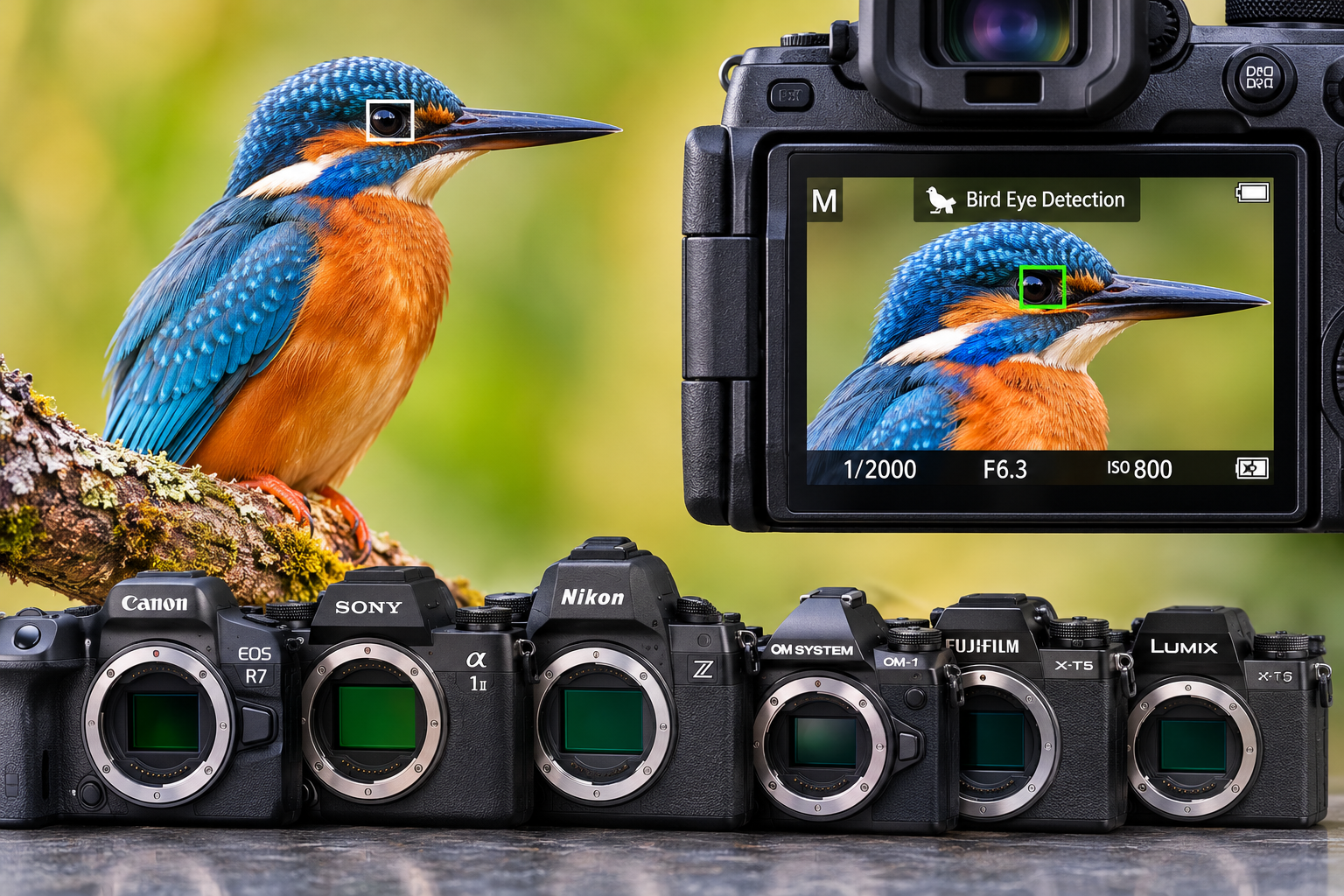
Bird Eye Detection has become one of the most useful autofocus tools for wildlife photographers. It can help a camera recognise a bird, identify its head or eye, and keep focus on the subject as it moves. Canon was among the brands that helped bring this kind of subject detection into mainstream mirrorless photography, but it is no longer alone. Sony, Nikon, OM System, Fujifilm and Panasonic all offer bird or animal detection on selected cameras.
So, is Canon’s Bird-Eye Autofocus really unique? The short answer is no. The more useful question is how each system behaves, which cameras offer dedicated bird detection, and how much difference it makes in real bird photography. There is no universal winner: performance depends on the camera body, lens, firmware, subject size, light, background and the photographer’s settings.
I have spent many years watching and photographing birds, and one thing remains clear: autofocus is a tool, not a replacement for fieldcraft. A camera that recognises an eye can make a difficult moment easier, but it cannot guarantee a sharp photograph every time.
What Does Bird-Eye Autofocus Actually Do?
Bird detection and eye detection are related, but they are not exactly the same thing. First, the camera attempts to recognise a bird in the frame. Depending on the model and situation, it may then identify the bird’s head or eye and place the focus target there. If the eye is not visible, the camera may continue tracking another recognised part of the subject or fall back to the selected AF area.
This is different from simply selecting a focus point and asking the camera to focus on whatever passes beneath it. Subject recognition adds another layer of information: the camera is trying to distinguish the bird from the background and maintain focus on the intended subject.
It is important not to imagine that every camera follows the same process or that every model detects a bird’s eye in every situation. A small bird far away, a bird partly hidden by leaves, a dark eye in dark plumage, or a fast-moving subject against a busy background can still challenge even an advanced AF system.
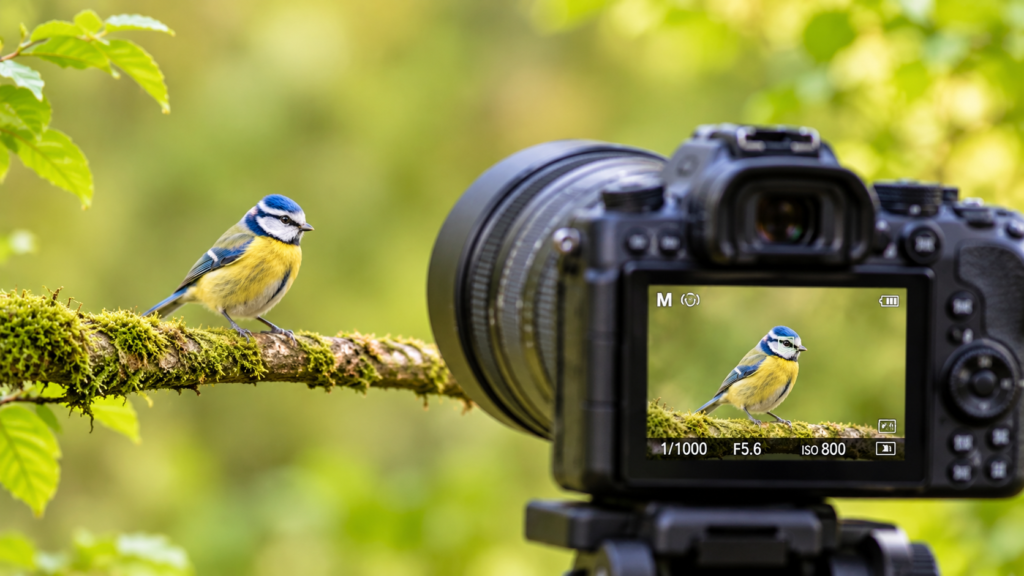
Canon: Animal Detection and Eye Detection
Canon uses Animal subject detection on compatible EOS R cameras. Depending on the model, the system can recognise birds as part of the Animals subject category and use eye detection when an eye is visible. On cameras such as the EOS R5 Mark II and EOS R1, this is supported by Canon’s more advanced subject-tracking and autofocus features.
Read the full Canon EOS R5 Mark II review
Read the full Canon EOS R1 review
One of Canon’s distinctive features on selected high-end bodies is Eye Control AF. On compatible cameras, the photographer can move the AF selection by looking at a position in the electronic viewfinder. This is not the same as bird-eye detection: it is an additional way to tell the camera where to prioritise focus. It can be useful when several potential subjects are in the frame, although its usefulness depends on setup, calibration and personal preference.
Canon’s AF system is highly configurable. Whole-area tracking can be convenient when a bird is moving freely against an uncluttered background, while a smaller AF area can give the photographer more control when branches or other objects compete for attention. The best choice changes with the scene rather than following one setting for every situation.
Sony: AI Subject Recognition and Real-Time Tracking
Sony offers Bird recognition on selected cameras, including the Alpha 1 II. Its dedicated AI processing unit supports subject recognition and Real-time Tracking. Sony has also continued to improve recognition through firmware, so it is worth checking the current firmware and exact model rather than assuming that every Alpha camera offers the same capabilities.
Read the full Sony Alpha 1 II review.
For bird photographers, the attraction is the combination of subject recognition, continuous autofocus and high-speed shooting. These features can help maintain focus as a bird changes direction or briefly becomes harder to see. They do not make every flight sequence effortless, however: the bird’s size in the frame, shutter speed, background and lens response still matter.
Nikon: Bird Detection and 3D Tracking
Nikon has developed its bird-detection autofocus across cameras such as the Nikon Z8 and Nikon Z9. The Z8’s firmware updates have specifically improved bird detection and tracking in complex scenes, including situations involving small or distant birds and high-contrast backgrounds. Nikon also offers 3D-tracking options that can be useful when following a subject through the frame.
Read the full Nikon Z8 mirrorless camera review.
Read the full Nikon Z9 mirrorless camera review.
As with Canon and Sony, it would be misleading to declare Nikon the automatic winner for birds among branches. Results depend on the AF area, subject-detection settings, firmware and the scene. Nikon’s continued firmware development is an important part of the story, and comparisons should always identify the camera and firmware being discussed.
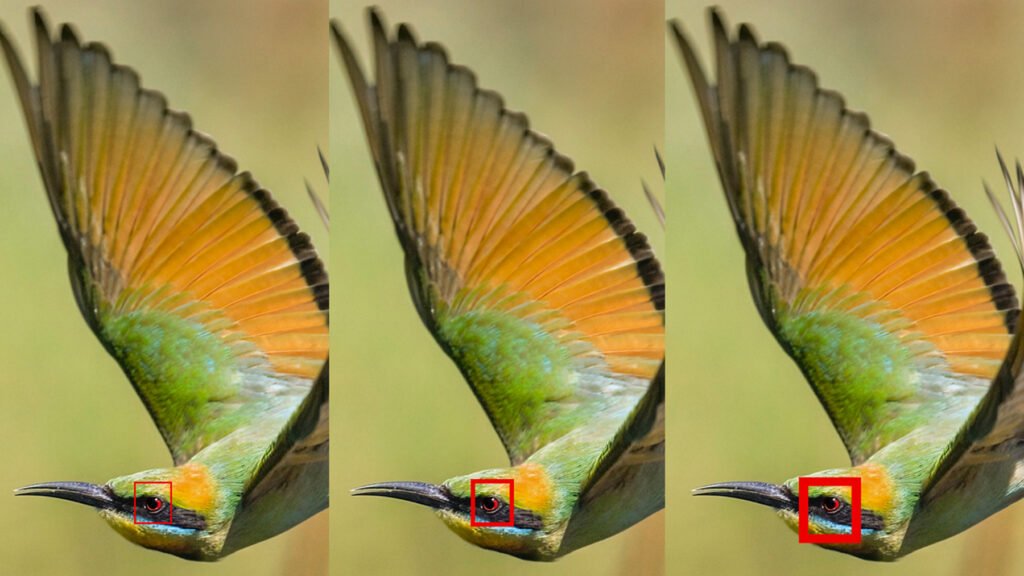
OM System: A Strong Bird Photography Option
OM System has made bird photography a clear part of its camera development. The OM-1 Mark II includes Intelligent Subject Detection AF with a dedicated Birds option, designed to recognise birds and track areas such as the head or eyes. It also combines this with features such as Pro Capture, which can record images from a buffer before the shutter is fully pressed.
The OM-5 Mark II features AI Subject Detection AF, helping photographers recognize and track subjects more effectively. However, its autofocus capabilities and subject-detection options differ from those of the flagship OM-1 Mark II, so it should not be considered an equivalent bird-detection system.
Read the full OM-5 Mark II camera review.
The Micro Four Thirds format gives the system a 2× angle-of-view crop factor compared with full frame. This can make it easier to build a relatively compact kit with substantial equivalent field of view. It does not physically turn a lens into a longer focal length, and it does not automatically mean that the complete camera-and-lens combination is half the weight of a full-frame alternative. Actual weight and image quality depend on the specific equipment.
Fujifilm: Bird Subject Detection
Fujifilm’s X-H2S offers subject-detection autofocus with a dedicated Bird setting. The camera combines this with a stacked sensor, high-speed continuous shooting and an AF prediction algorithm designed to track moving subjects. Firmware has also improved subject detection and tracking since the camera’s launch.
That makes the X-H2S a serious option for bird and wildlife photography. As with every system, performance should be judged in the context of the complete setup and the shooting conditions, not by burst rate or a single marketing claim alone.
Panasonic Lumix: Bird Recognition Within Animal Detection
Panasonic’s Phase Hybrid AF cameras, including the Lumix S5II family, offer subject detection that includes animals. Panasonic’s documentation identifies birds among the animals the system can recognise. The camera can select the animal’s body or eye/body target options, depending on the model and settings.
This is a meaningful improvement over Panasonic’s earlier contrast-based autofocus generations. However, bird recognition should not be confused with a guarantee of flagship-level tracking in every demanding action situation. Photographers considering a Lumix body should look at the exact model, firmware and their intended subjects before making a system decision.
Bird Detection Compared: What the Main Systems Offer
The table below compares documented features rather than claiming that one brand is objectively the fastest or most accurate. These are selected camera families, not every model from each manufacturer. Features and menu names can vary by body and firmware.
| System | Selected camera examples | Bird recognition approach | Other relevant feature |
|---|---|---|---|
| Canon | EOS R5 Mark II, EOS R1 | Animals subject detection, with eye detection on compatible models | Eye Control AF on selected bodies |
| Sony | Alpha 1 II | Dedicated Bird recognition within AI subject recognition | Real-time Tracking and Pre-Capture |
| Nikon | Z8, Z9 | Dedicated Bird detection | 3D Tracking and firmware-based AF improvements |
| OM System | OM-1 Mark II | Intelligent Subject Detection with Birds option | Pro Capture |
| Fujifilm | X-H2S | Subject Detection with Bird setting | Stacked sensor and high-speed bursts |
| Panasonic | Lumix S5II family | Animal detection includes birds | Phase Hybrid AF and subject-part selection |
Why Bird-Eye AF Can Still Miss the Eye
Even a sophisticated recognition system has limits. A bird that occupies only a tiny part of the frame may not provide enough detail for reliable eye detection. Dense vegetation can confuse subject recognition, while a bird turning away may hide its eye. Dark plumage, poor light, motion blur and low contrast can also make detection less reliable.
There is another practical point: a focus box over the eye does not guarantee that the photograph will be sharp. Shutter speed, subject movement, camera movement, depth of field and lens performance all contribute to the final result. Eye detection helps the camera choose where to focus; it cannot solve every part of exposure and image-making.
Practical Canon AF Tips for Bird Photography
Canon’s menu options differ between camera generations, so treat the following as starting points rather than universal settings. Check the manual for your exact EOS R body and firmware before copying a button assignment or menu path.
1. Choose the AF Area for the Situation
For a bird flying against a relatively clean sky, a wider AF area with subject tracking can make it easier to acquire and follow the subject. For a small bird sitting among branches, a smaller or flexible AF area may help you place the initial focus more deliberately. If automatic detection keeps choosing the wrong object, temporarily taking more control can be faster than fighting the camera.
2. Use Servo AF for Moving Birds
Servo AF is the normal starting point for birds that may move, take off or change direction. The best tracking sensitivity and acceleration settings depend on how predictable the movement is and how much foreground clutter is present. There is no single Case setting that is ideal for every birding situation.
3. Set Up a Quick Alternative to Subject Detection
Consider assigning a convenient button to an AF area or focusing method that gives you more direct control. This can be useful when a bird is partly hidden or the camera repeatedly detects a branch. Button customisation differs by model, so use the camera manual rather than assuming the same AF-ON or star-button assignment works across the entire EOS R range.
4. Check Pre-Continuous Shooting Compatibility
Pre-Continuous Shooting is not available on every Canon EOS R camera. Canon documents it for specific newer bodies, including the EOS R6 Mark III, and also lists compatibility for selected lenses on certain other bodies such as the EOS R1 and EOS R5 Mark II. Do not assume that the EOS R6 Mark II or EOS R7 has the same feature. Check Canon’s current compatibility list for your exact body and lens combination.
The Lens Matters, but Adapted EF Lenses Are Not Automatically a Weak Link
Autofocus performance is a combination of the camera body, lens, settings and subject. A lens needs to communicate correctly with the camera and move its focusing elements quickly and accurately. Different lenses use different focus-motor designs, so it is not accurate to describe every RF telephoto as using the same motor technology.
Canon’s EF lenses can work very well on EOS R bodies with the appropriate EF-EOS R mount adapter. An adapted EF 100-400mm f/4.5-5.6L IS II USM, for example, is not automatically too slow for bird photography. Performance varies by lens model, condition, subject movement and camera body. Some third-party lenses may have compatibility or firmware limitations, so check the specific lens rather than treating all adapted glass as one category.
Before replacing a lens because of missed focus, check the AF settings, shutter speed, focus limiter (if available), lens condition and technique. A newer lens can help in some situations, but a lens upgrade is not a guaranteed fix for every autofocus problem.
So, Is Canon’s Bird-Eye Autofocus Really Unique?
No. Canon has a capable bird and animal detection system, and Eye Control AF gives selected EOS R bodies an unusual additional way to direct autofocus. But dedicated bird recognition is now available across several competing mirrorless systems. Sony, Nikon, OM System and Fujifilm offer dedicated bird settings on selected cameras, while Panasonic includes birds within its animal-detection system.
I would not recommend changing camera systems simply because another brand’s bird-detection feature sounds more advanced. Look at the lenses you need, handling, viewfinder, autofocus controls, buffer and overall kit weight. Then consider how the camera performs with the birds you actually photograph.
For me, the most important point is that technology should make time in the field more rewarding, not turn every outing into a comparison of specifications. Bird detection is valuable, but patience, knowing bird behaviour, choosing a good position and understanding light still matter enormously. The best camera is the one that helps you make the photographs you want—and that you enjoy carrying outdoors.
Official References and Further Reading
- Canon EOS R5 Mark II: Eye Detection AF
- Canon EOS R5 Mark II: AF settings for small and flying birds
- Canon EOS R5 Mark II: Pre-Continuous Shooting
- Sony Alpha 1 II: Subject Recognition AF
- Nikon Z8: Bird Detection AF improvements
- OM System OM-1 Mark II: Intelligent Subject Detection AF
- Fujifilm X-H2S: Subject-detection autofocus
- Panasonic Lumix S5II: Operating instructions and animal detection
Frequently Asked Questions (FAQ)
Not strictly better—just different in how it prioritizes subjects. Canon’s Dual Pixel CMOS AF II is unmatched in initial acquisition speed and low-light sensitivity, grabbing tiny birds across the frame almost instantly. However, Sony excels at predictive AI tracking for erratic birds in flight, while Nikon’s 3D tracking is superior at ignoring foreground branches and dense foliage.
Flagship and upper-tier mirrorless models equipped with the DIGIC X or DIGIC Accelerator processors offer the best performance. The Canon EOS R1 and EOS R5 Mark II represent the pinnacle of Canon’s tracking, featuring Action Priority and Eye Control AF. For enthusiasts and crop-sensor shooters, the EOS R6 Mark II and EOS R7 also deliver remarkable, reliable bird-eye tracking.
Yes. While older Panasonic cameras struggled with contrast-based autofocus, newer hybrid Phase Detection models like the Lumix S5II and S5IIX feature capable AI-driven animal and bird detection. Paired with L-Mount telephoto lenses and class-leading image stabilization, Panasonic is now a solid option for wildlife photography, even if it trails Canon and Sony slightly in extreme high-speed flight tracking.
Aggressive subject-detection algorithms can get confused by high-contrast twigs sitting between your lens and the bird. To fix this on a Canon body, lower your Tracking Sensitivity to -1 or -2 (Case 2) so the focus does not jump easily, and set up a secondary back-button with Spot AF (Subject Tracking OFF) to manually punch through dense cover.
Affiliate Disclosure: This article contains affiliate links. If you purchase through these links, GoToBirding may earn a small commission at no extra cost to you. This helps support the site and its mission to share knowledge, tips, and honest reviews for bird and nature photography enthusiasts.
About the Author
Lorand Vigh is a nature conservation engineer and lifelong birder with more than 30 years of hands-on experience in bird monitoring, habitat protection, and cross-border conservation projects. Through GoToBirding, he combines his ecological background with decades of wildlife photography to deliver honest, field-tested gear reviews and practical birding guides.