
Introduction
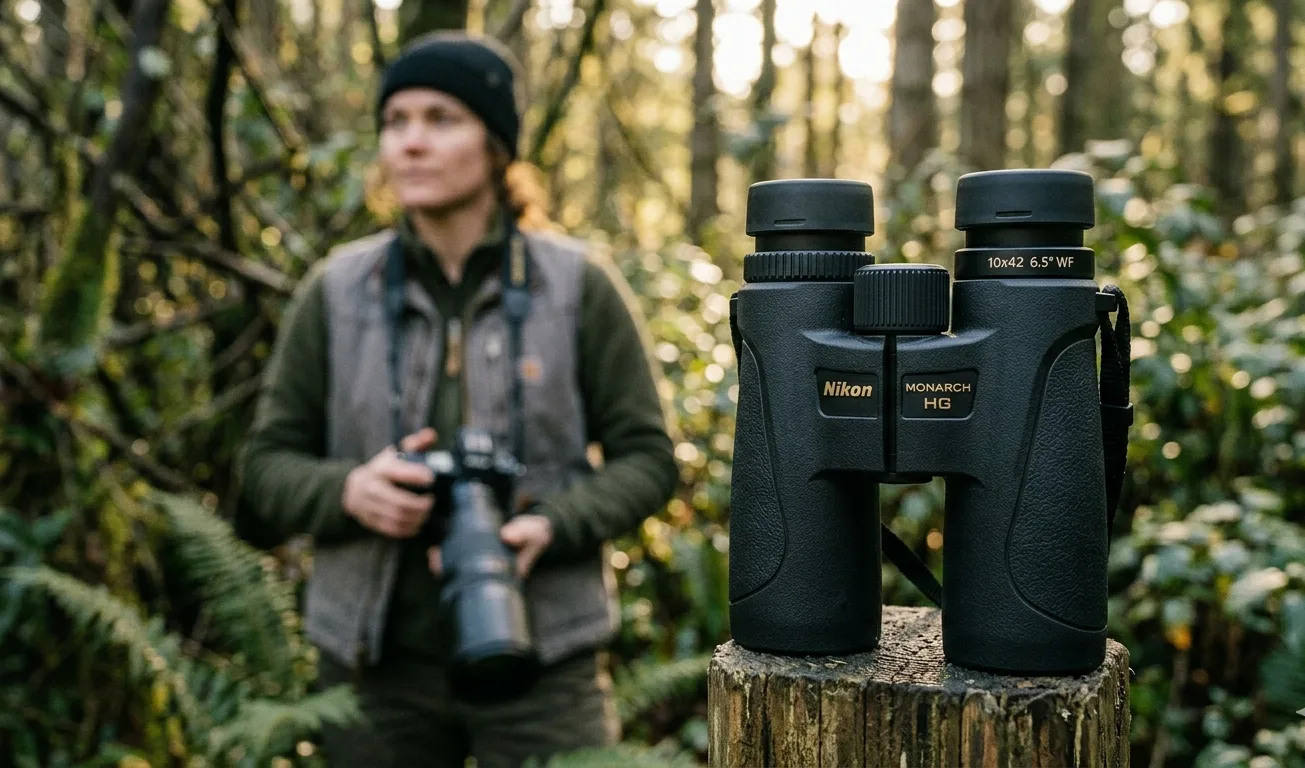
Today, I am talking about the Nikon Monarch HG 10×42 binoculars. Why this specific pair? Because the internet is flooded with reviews written by people who have probably never spent a freezing dawn crouching in the mud, or hiked for hours through a dense forest while heavy gear dragged down their necks. I’m not a salesperson; I’m a content creator who loves premium quality but hates it when overpriced marketing lacks real substance.
In this brutally detailed, deep-dive review—which is more of an honest conversation between friends than a traditional product description—we are going to strip this optic down to its bare bones. We’ll look at its real-world performance, its design flaws (because yes, they do exist!), and whether it’s actually worth investing the serious cash they are asking for it.
Grab a notebook, lean back, and let’s see if the Monarch HG is truly the right tool for you, or just another shiny piece in a crowded premium market.
The Truth About Premium Binoculars: Why the Nikon Monarch HG?
When I started getting more serious about birding and wildlife photography, I quickly realized a fundamental truth: bad optics aren’t just annoying; they completely ruin the experience. Do you know that feeling when you spot some movement in a dense thicket, lift your binoculars, and all you see is a blurry, grayish blob? Or when a beautiful kingfisher flashes by the water, but by the time you manage to sharpen the image, your eyes are already strained from struggling with an unstable focus?
The market is packed with so-called “entry-level” and “mid-range” gear that looks great on paper. But let’s be real: if you are serious about your hobby, or if documenting wildlife is part of your job, the “good enough” level just won’t cut it. That’s where the Nikon Monarch HG series comes in. The Japanese manufacturer positioned it just below their legendary EDG lineup, but engineered it so well that its performance comes dangerously close to flagship quality—minus the luxury price tag that requires a second mortgage.
What Does “HG” Stand For?
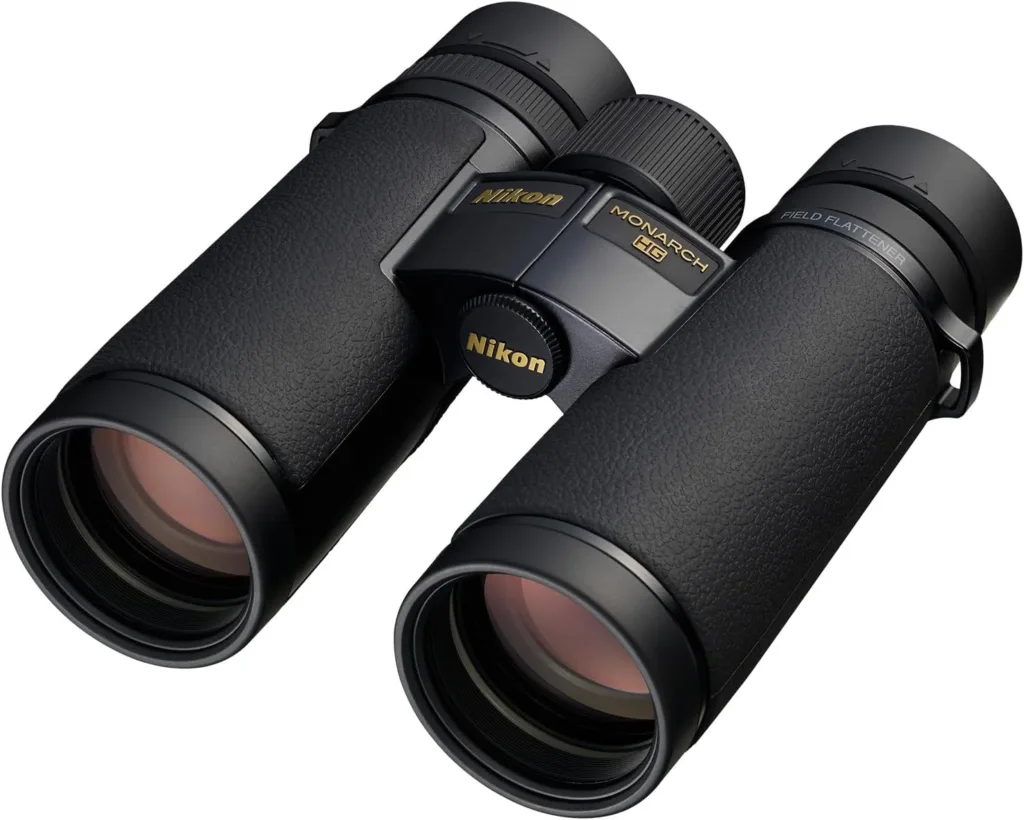
HG stands for High Grade, which in Nikon’s language means: “We threw everything our engineering team had at this, without making you pay for the design-heavy gimmicks of the ultra-luxury tier.” These binoculars are built for people who don’t care about flexing a brand name in front of other birders, but who want to see. To see the exact texture of feathers even in brutal backlighting, and to track birds of prey mid-flight without the edges of the field of view turning into a blurry mess.
A Deep Dive Into Optical Characteristics: What Are You Paying For?
Let’s move past the technical jargon and translate the specifications into real-world terms. If you look at the factory spec sheet, it’s packed with terms like ED glass, phase-correction coating, and dielectric anti-reflective multilayering. But what does all of that actually mean when you’re standing on a foggy lake shore at 5:30 AM?
The Magic of ED Glass (Extra-low Dispersion)
Let’s start with the most critical factor: chromatic aberration, also known as color fringing. This is that annoying purple or greenish halo that appears at the boundaries of high-contrast subjects—like a dark bird perched against a bright sky. In cheaper binoculars, this can be so severe that it completely washes out fine details.
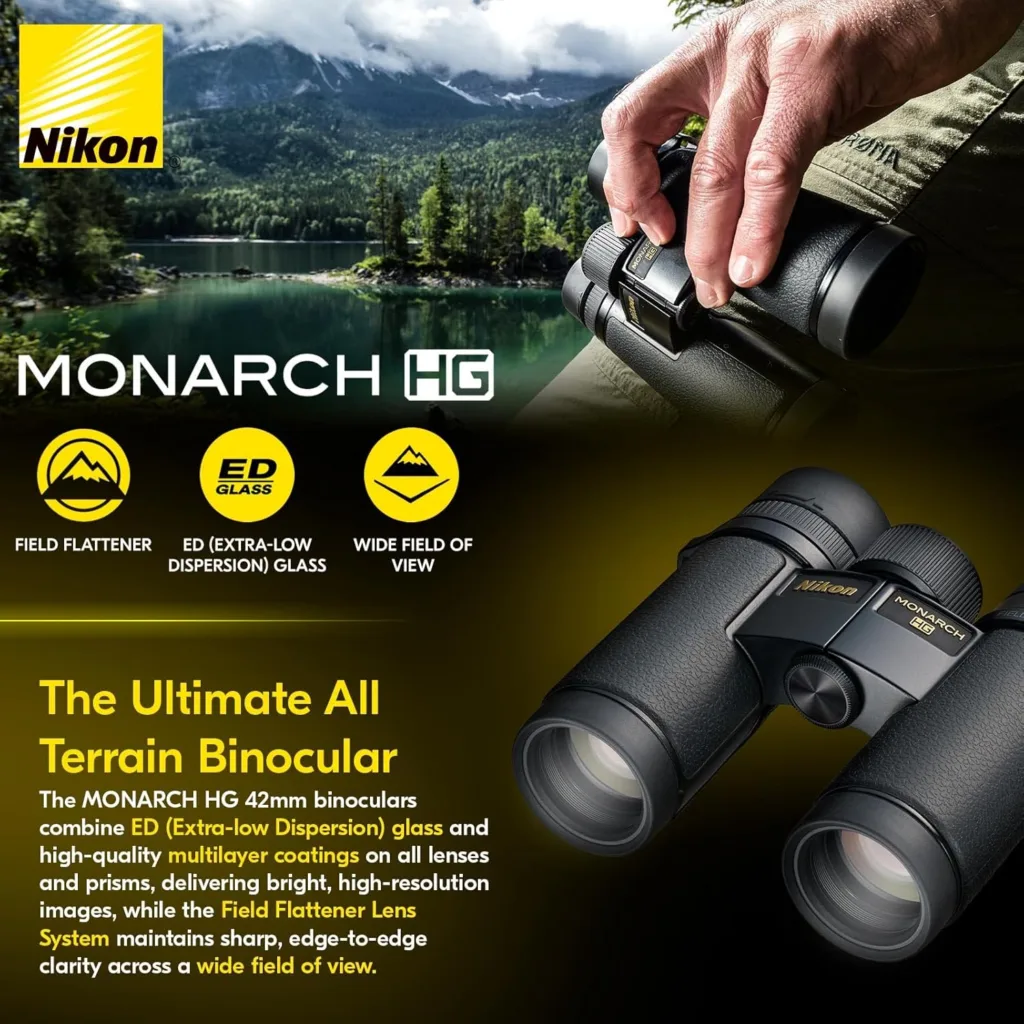
The ED (extra-low dispersion) glass used in the Monarch HG is specifically designed to eliminate this issue. When you look through it, the image is shockingly clean. It genuinely feels like there is no glass between your eyes and reality. The colors aren’t artificially oversaturated, yellowish, or blueish; they are exactly as nature intended. If you are trying to identify the subtle markings of a rare warbler in the dim morning light, this color fidelity and contrast will save your day.
Field of View: The Ultimate Game Changer
Let’s talk numbers: 341 feet at 1,000 yards (around 114 meters at 1,000 meters). For a pair of 10x magnification binoculars, this is exceptionally wide. Why does this matter to you?
Imagine trying to track a tiny, hyperactive kinglet inside a dense canopy. If your field of view is narrow (which is the Achilles’ heel of most 10×42 binoculars), the bird disappears from your frame with a single hop, and you have to start your search all over again. Looking through the Monarch HG feels like watching a widescreen movie. You get all the benefits of 10x magnification (bringing details closer than a classic 8x), but you don’t lose the context of the surroundings. Tracking raptors like a sparrowhawk or a peregrine falcon in mid-air becomes exponentially easier with a field of view like this.
Field Flattener Lens System
This is a feature most marketers forget to mention, even though it’s exactly what separates the amateurs from the pros. With many binoculars, the center of the image is razor-sharp, but as you glance toward the edges, the view distorts or loses focus. Nikon’s engineers integrated a field flattener lens system to ensure that the image remains sharp right to the absolute edge of your view. You don’t have to constantly position the bird dead-center to see its details; if it pops up in the corner of your frame, you get a perfectly clear image right there.
Ergonomics and Build Quality: Built to Survive
Okay, so the optics are brilliant. But how do they feel in your hands? Because if a piece of gear is heavy, slippery, or uncomfortable, it’s going to end up sitting on a shelf at home. And the most expensive binoculars in the world are completely worthless if you don’t bring them with you.
Magnesium Alloy Chassis
Nikon didn’t cut corners on materials, but they kept a close eye on the weight. The body is built from a magnesium alloy, a material heavily relied upon in aerospace engineering. Thanks to this, the binoculars weigh in at just 23.6 ounces (670 grams). This makes them one of the lightest models in their class.
When you first pick them up, there is a distinct sense of dense, premium quality. You can tell they are built solid, but they won’t strain your neck during an all-day trek. The rubberized exterior armor doesn’t just protect the device from physical impacts and scratches; it provides an incredibly secure grip. Whether it’s pouring rain or your palms are sweating in the summer heat, the Monarch HG isn’t going to slip out of your hands.
Weatherproofing at the Highest Level
Let’s talk about the elements. Birdwatching and wildlife photography rarely happen in sterile, climate-controlled studios. More often than not, the most exciting things happen when the weather goes completely wild.
The Monarch HG is nitrogen-purged and tightly sealed with O-rings. What does this mean in practice?
Fog-proof: You know that frustrating moment when you step out of a heated car into a freezing winter morning, and your optics instantly fog up internally, rendering them useless for hours? Yeah, that won’t happen here. The internal gas purging prevents internal condensation, making them instantly ready for action regardless of sudden temperature swings.
Waterproof down to a depth of 16.4 feet / 5 meters (though I hope you won’t be scuba diving with them).
Detailed Specification Table and Deep Analysis
To make sure I’m not just talking hot air, let’s look at the hard data, because numbers don’t lie. But I promise, we will immediately break down what these figures actually mean in real life.
| Specification / Feature | Detailed Data and Technical Metrics |
| Magnification | 10x |
| Objective Lens Diameter | 42 mm |
| Lens Coatings | Fully Multi-Coated with ED Glass |
| Field of View | 341 feet at 1,000 yards (6.5-degree real angle of view) |
| Close Focus Distance | 6.6 feet / 2.0 meters |
| Eye Relief | 17.8 mm |
| Exit Pupil Diameter | 4.2 mm |
| Prism Type | Roof Prism with Dielectric Coating |
| Waterproof / Fog-proof | Yes (Nitrogen-Filled, O-Ring Sealed) |
| Body Material | Premium Magnesium Alloy |
| Weight | Approx. 23.6 ounces / 670 grams |
| Dimensions (LxW) | 6.3 x 5.1 inches / 160 x 131 mm |
| Phase-Correction Coating | Yes (for enhanced brightness and contrast) |
| Tripod Adaptable | Yes (requires a separate adapter) |
| Diopter Adjustment | Yes, with a locking mechanism |
Why Do These Numbers Matter to You?
The 6.6-foot Close Focus: Many people assume binoculars are only meant for distant objects. But have you ever thought about how stunning a butterfly sitting on a flower just two meters away looks, or the intricate pattern on a dragonfly’s wing? This feature creates a bridge between macro observation and long-distance viewing, adding an incredible layer of versatility.
The 17.8 mm Eye Relief: If you wear glasses, this is your lifesaver. With many binoculars, you have to fold back the rubber eyecups or smash the lenses right against your face to see the full picture. Here, thanks to the multi-position turn-and-slide eyecups, you can adjust the distance perfectly. You get the full, wide field of view with your glasses on, without any dark edges or vignetting.
The 4.2 mm Exit Pupil: This determines how much light reaches your eyes in low-light conditions. While an 8×42 model theoretically offers a larger exit pupil (5.25 mm), the brilliant lens coatings of the Monarch HG compensate for this difference. You get a surprisingly bright image even inside a dark, dense forest or minutes after sunset.
Real-World Field Performance: The Good, the Bad, and the Honest Truth
Now we’ve arrived at the most important part. Forget the laboratory tests; let’s talk about what it’s actually like to use these binoculars out in the wild. I evaluated three main aspects that are critical for every birder and photographer.
Low-Light Performance: When the Light Fades
Most cheap binoculars perform beautifully in bright, direct sunlight. But wildlife isn’t particularly active during the midday sun. The most exciting moments happen during the first light of dawn or the final minutes of sunset—exactly when light is dramatically scarce.
During my field tests with the Monarch HG, the dielectric multilayer prism coating truly showed its power. This technology allows more than 99% of light to pass through the prisms. What does that mean? When you can barely make out silhouettes with the naked eye among the bushes, looking into the binoculars feels like someone suddenly “turned the lights on.” I was able to distinguish the ear tufts and eye color of a long-eared owl in lighting conditions where mid-range optics showed nothing but a black blob. If you love dawn or dusk watches, this capability alone makes the investment worth it.
Focusing Speed and Precision: The Critical Point
And here is where I have to be completely honest with you. There is no such thing as a perfect product, and the Monarch HG has its own quirk that you will need to get used to. That is the focus wheel.
The focusing mechanism is incredibly precise. There is no play, no wobbling, and it adjusts very smoothly. However, the factory setting is quite stiff, a bit “heavy.” If you are used to the loosely spinning plastic wheels of cheaper models, this will feel strange at first. It takes time for the mechanics to break in, and for your hand to adjust to the higher resistance.
The upside? You won’t accidentally shift your focus if the wheel rubs against your jacket or your gear. But if you need to track a lightning-fast small bird darting through branches, you might struggle a bit with speed during your first few days. This isn’t a defect; it’s a design choice built for long-term durability—but you need to know about it.
The Diopter Lock: A Small Touch That Saves Your Sanity
How many times have you perfectly adjusted your binoculars to your eyes, only to pull them out of your bag later and realize the diopter ring has shifted? Nikon found a simple but brilliant solution for this: a locking diopter system. You set your desired value, push the ring back down, and it locks in place. It cannot move on its own while you are moving around in the field. This is the exact kind of user-centered design I expect from a premium piece of gear.
How to Integrate These Binoculars Into a Photography Workflow?
Since many of you don’t just observe nature but also photograph or record it (after all, content creation is our lifeblood!), it’s important to talk about how the Monarch HG fits into a more complex workflow.
The Importance of Scouting
Before you pull out your heavy 500mm or 600mm telephoto lens, you need to find your subject. Panning around your environment with a camera pressed to your eye causes two things to happen:
- Your arms and shoulders get incredibly tired from holding up multiple kilograms of gear.
- The narrow field of view causes you to miss the bigger picture.
The Monarch HG is the ultimate scouting tool. Hanging around your neck, you barely feel it. With its wide field of view, you can scan an area rapidly, and once you have pinned down the exact location (like a kingfisher’s favorite perch), you can set up your camera and tripod with precision. This saves you time, saves your energy, and drastically increases your hit rate for successful shots.
Digiscoping: Shooting Through Your Binoculars
While the Monarch HG isn’t a spotting scope, the smartphones we have today paired with universal adapters make it excellent for digiscoping. If you don’t have your professional photography gear on you but a moment presents itself, you can easily mount your phone to the eyepiece. Thanks to the Monarch HG’s outstanding optical clarity and minimal chromatic aberration, the photos captured through your phone turn out surprisingly sharp, contrast-rich, and detailed. It’s a perfect solution for instant social media updates or documentation purposes.
Price-to-Value Ratio: Is This Heavy Investment Worth It?
Let’s talk about the elephant in the room: the price. The Nikon Monarch HG is not cheap. When you drop this kind of money on a pair of binoculars, you have every right to ask yourself: Am I ok? Couldn’t I get something similar for a fraction of the cost?
Let’s look at this question with a strategic, “Boss” mindset.
If you buy a 150–200 USD entry-level pair of binoculars, in about 2 or 3 years:
- They will likely fog up internally because the seals will give out.
- The plastic components or the rubber armor will start to degrade and turn sticky.
- You will constantly feel a sense of compromise whenever lighting conditions get tough.
You aren’t buying the Monarch HG for 3 years. This tool is built for decades. The magnesium chassis, scratch-resistant lens coatings, and Nikon’s service infrastructure ensure that these binoculars will still be serving you long after your current camera or phone has ended up in an electronic recycling bin.
When you break down the cost over the lifespan of the tool, or weigh it against the frustration saved by having crystal-clear vision, you realize this isn’t an expense—it’s an investment. An investment in your passion, the quality of your work, and that unrepeatable experience of truly connecting with nature.
Who is the Nikon Monarch HG For, and Who Should Skip It?
Let’s keep it real. These binoculars are fantastic, but they aren’t for everybody. Let me help you decide if they belong in your gear bag.
Do NOT buy them if:
- You are just a casual weekend hiker: If you only go for a walk in the woods with your family twice a year, and you just want a pair of binoculars to look at a distant observation tower, this level of optical performance is an unnecessary luxury. A pair from the Nikon Prostaff or Monarch 5 lines will be more than enough for you, and you can spend the rest of your money on travel.
- You are looking for an ultra-light, pocket-sized tool: Even though 670 grams is light for the 10×42 category, this is still a full-sized pair of binoculars. You won’t be able to slip them into a pocket; they require a neck strap or a proper harness. If you are a minimalist ultra-light backpacker, look into the 8×30 or compact pocket categories instead.
Buy them immediately if:
- Birding is your passion or your job: If you spend hours out in the field, if it’s critical for you to identify species based on tiny details, and you refuse to compromise on image quality.
- You are a wildlife photographer: If you need a reliable, rugged scouting tool that can handle mud, rain, and cold weather, and won’t fail you during critical dawn hours.
- You appreciate premium engineering: If you love objects that look and feel like they were designed by experts for real-world utility, rather than built as disposable consumer goods.
Final Thoughts: The Experience of Sight
When you pack up your gear at the end of the day and scroll through your memory cards, you realize that birdwatching and wildlife photography aren’t actually about technical parameters. They are about patience, observation, and the pure joy of discovery. They are about that fleeting moment when you temporarily become a part of nature, witnessing things most people completely miss in the rush of their daily lives.
The Nikon Monarch HG 10×42 won’t wake up early for you. It won’t find that rare bird hidden deep in the brush for you. But when you are out there, ready, and you lift them to your eyes, it opens up a window to the world that fundamentally changes how you see nature.
Yes, the focus wheel is a bit stiff in the beginning. Yes, the price tag means you have to think twice before purchasing. But the absolute clarity, the massive field of view, and the reassuring peace of mind that this tool will survive any weather conditions easily make it one of the absolute best options in its class.
It’s your journey and your choice. But if you ask me: if you are serious about growing and stepping up your game in this space, the Monarch HG is a companion that will faithfully serve you across your adventures for decades to come.
Frequently Asked Questions (FAQ)
Are the Nikon Monarch HG 10×42 binoculars worth the money for a casual birdwatcher?
Honestly? Probably not. If you only head out to a local park a couple of times a year or want to glance at the birds visiting your backyard feeder, the Monarch HG is an unnecessary luxury. You will be incredibly happy with a mid-range alternative like the Nikon Monarch M5 or M7, which offer fantastic quality for a fraction of the price. The Monarch HG is designed for power users—serious birders, wildlife photographers, and field researchers who spend hours in harsh conditions and need absolute optical perfection.
Why choose the 10×42 model over the 8×42 version?
It all comes down to a trade-off between magnification and stability. The 10×42 model brings distant subjects closer, allowing you to pick out fine details on rare birds or read identification bands from afar. The tradeoff is that 10x magnification amplifies your natural hand tremors slightly more than an 8x model, and it gives you a slightly narrower field of view. However, because the Monarch HG 10×42 has an exceptionally wide field of view for its class, it effectively bridges that gap, giving you the extra reach without feeling like you are looking through a straw.
Can I use the Nikon Monarch HG 10×42 if I wear glasses?
Absolutely. This is actually one of the standout features of this model. The Monarch HG features a generous 17.8mm of eye relief alongside multi-position turn-and-slide click-stop eyecups. This means you can twist the eyecups completely down, rest them against your glasses, and still see the entire widescreen field of view without any annoying black rings or cut-off edges around your vision.
How does the stiff focus wheel perform in freezing weather?
This is a very common concern because the focus wheel is intentionally designed with a tight, high-resistance mechanical feel to prevent accidental shifting in the field. Because the body is sealed and packed with specialized lubricants, it does not lock up or freeze in sub-zero temperatures. It will feel noticeably firmer when it’s freezing outside compared to a hot summer day, but it remains smooth, predictable, and fully operational.
Is it possible to mount these binoculars on a tripod?
Yes, they are completely tripod adaptable. If you remove the small cap at the front of the central hinge between the two barrels, you will find a standard threaded socket. You will need a separate, relatively inexpensive tripod adapter (Nikon makes an official one, though third-party options work just as well) to clamp them down. Mounting a 10x binocular on a tripod is a game-changer for long periods of stationary scanning, such as lake monitoring or hawk-watching, because it completely eliminates hand fatigue and image shake.
Thank you for joining me for this deep dive! If you enjoyed this honest, no-nonsense style and want to read more real, experience-based reviews on top-tier optics and photography gear, click through to explore our other detailed breakdowns of premium binoculars.
Read more reviews of other high-quality binoculars HERE
Note: Some of the links scattered throughout this post are affiliate links. What does that mean for you? Absolutely nothing changes on your end—you don’t pay a single penny extra.

Lorand Vigh is a nature conservation professional and lifelong birder based in Serbia (Vojvodina). With over 30 years of field experience in birdwatching, habitat protection, and conservation management, he has worked on bird monitoring projects, habitat restoration initiatives, and cross-border conservation cooperation. GoToBirding is a personal project built on real field experience, sharing practical, science-based advice for birders and wildlife photographers.